
American traditional: a rose can teach you to draw with more intention
Two historical flash sheets offer a practical drawing lesson: deciding what an image needs to be understood. Explore outlines, colour and a short exercise on paper.
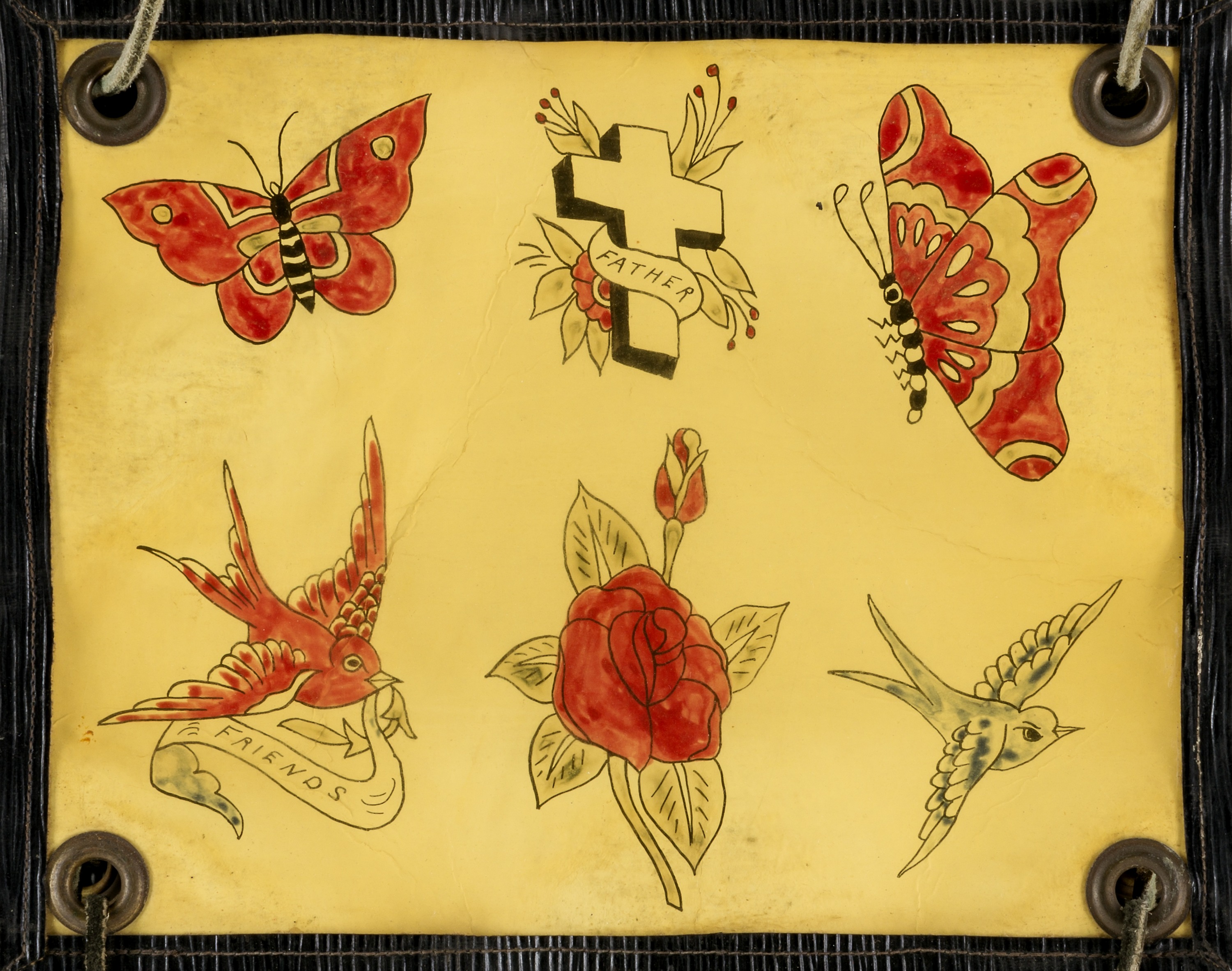
A rose, a few leaves and a decision
You start drawing a rose and, almost without noticing, spend twenty minutes adding petals. There are more lines, but the flower is no easier to read. That familiar problem offers a useful way into American traditional: look at what makes a drawing recognisable before trying to make it more complex.
Approach the style with one question: if you had to remove half the details, what would you keep? This exercise is about learning to choose. A simple image can demand very precise decisions.
An archive gives us names and dates
The Mariners’ Museum records that Cap Coleman settled in Norfolk in 1918. In 1936, it acquired equipment from his studio and commissioned sheets of designs. Its catalogue preserves one of those works dated that year. This gives us a concrete reference for studying the craft without treating one artist as the origin of an entire tradition.
Look at the outline first
For this exercise we use two sheets by an unidentified artist, dated to the 20th century by the Smithsonian. On the cover sheet, a rose is built from a few outlined petals and clearly separated leaves.
From subject to structure
Try looking at one of your own sketches from a distance. Before judging its finish, find the focal point: a flower head, a bird’s direction or the curve of a banner. Then examine the outer contour. If several parts overlap without a clear intention, adding little lines inside often postpones the important decision.
In a drawing exercise, line weight can help organise what the viewer notices. Give the strongest mark to what you want recognised first, then check whether the details support that route through the image. You do not need to turn this into a rigid formula: start with an intention and compare the result.
Black shapes do structural work too

Plan the colour before decorating
For your own study, pick one leading colour and decide where it will go first. A small palette asks you to choose which areas share importance and which should feel quieter. If every part demands attention, return to the sketch and try a more restrained version.
You can also compare an outline drawing with another version containing solid black shapes. Ask what you have gained: a stronger direction, depth or a clearer separation? If the answer is simply “it looks fuller”, that shape may still need a purpose.
A twenty-minute experiment
Work on paper, starting with a flower you can observe or a photograph you have taken. The time limit is a suggestion to keep you from getting stuck in the details.
- Draw three small silhouettes and choose the easiest one to recognise.
- In a second sketch, decide which internal lines are essential.
- Add one colour and a few black shapes, each with a clear purpose.
- Compare the versions at a small size and note what you would remove or restore.
Learn from the style without stopping at a recipe
Keep the rejected sketches too. They will help you explain why you chose one shape over another. Being able to discuss a decision is more useful for learning than collecting a checklist of familiar motifs.
Historical sheets offer something to study, not a request to repeat somebody else’s piece as your own. Look at how they organise information, then return to your reference. Your next rose might have fewer petals and still communicate what you wanted to draw more clearly.
Sources and editorial notes
- The Mariners’ Museum — Cap Coleman, archivo del estudio
- The Mariners’ Museum — Designs of the Tattooers Art, 1936
- Smithsonian American Art Museum — Tattoo Flash, 1998.84.50C
- Smithsonian American Art Museum — Tattoo Flash, 1998.84.50D
Manufacturer and organiser facts are linked above. Our selection and reading advice expresses TattooXpert’s editorial judgement.
Our editorial methodKEEP EXPLORING.
Neotraditional tattooing: beyond pretty flowers and bold colour
Learning to draw neotraditional designs starts with more than choosing a subject. Explore its influences, study real artwork and try an exercise in line, hierarchy and colour.
TattooXpert
Blackwork: learning to draw the space you leave untouched
Black catches the eye; the space around it makes the composition work. Explore history, artists and four real photographs before taking those ideas into your sketchbook.
TattooXpert