
Tattoo stroke, needle hang and depth: three measurements to keep separate
Machine travel, the needle tip outside a cartridge and penetration into skin use different reference points. Here is how to read them without turning a specification into a depth prescription.
The three questions hiding behind one number
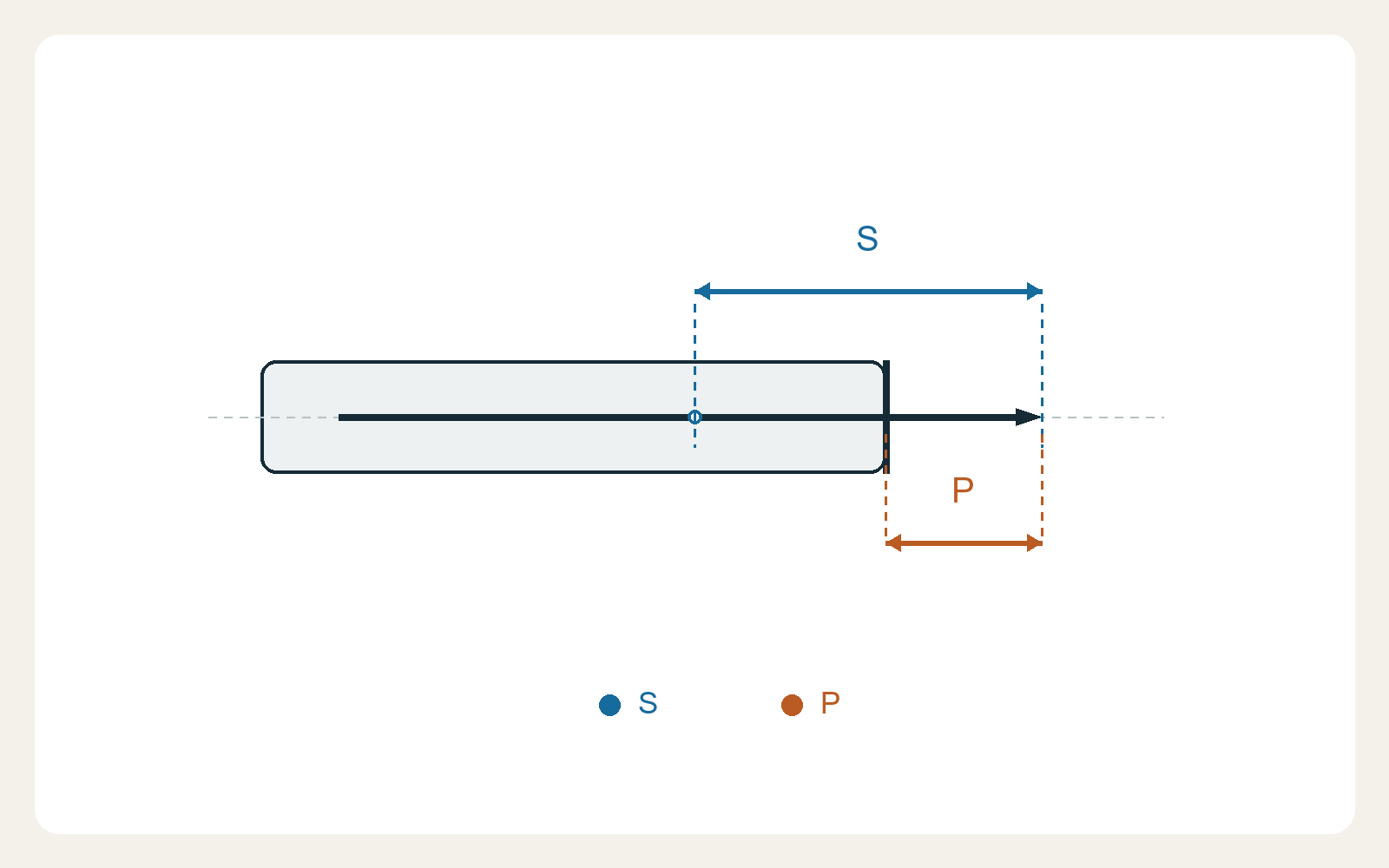
A machine lists a 3.5 mm stroke, while a separate adjustment changes how far the needle appears to stick out. It is easy to start discussing both as though they set the same thing. They do not: stroke describes mechanical travel; needle hang, or protrusion, describes the tip beyond the cartridge nozzle; penetration depth describes how far the tip enters relative to the skin surface during use.
All three can involve millimetres, but their reference points differ. A stroke specification is not an instruction for how deeply to tattoo. Keeping the terms separate helps you read a manual, ask a mentor a useful question and spot an explanation that quietly switches from one measurement to another.
Stroke is the distance between two extremes
In a rotary machine, the drive turns motor rotation into a back-and-forth movement. Stroke length describes the distance between the extreme positions of the part driving the needle. In an idealised diagram, you can mark its furthest back and furthest forward positions and identify the gap between them.
The stroke value does not add the outward and return journeys together. Nor does it tell you how often the movement repeats each second: that is frequency. A drawing can show a longer journey repeating slowly or a shorter one repeating quickly. Distance and repetition rate answer different questions.
When comparing specifications, check exactly what the manufacturer describes. Our diagram simplifies the transmission. It is not a measurement of every cartridge's movement under load or a representation of a particular machine's tolerances.
Needle hang uses the nozzle as its reference
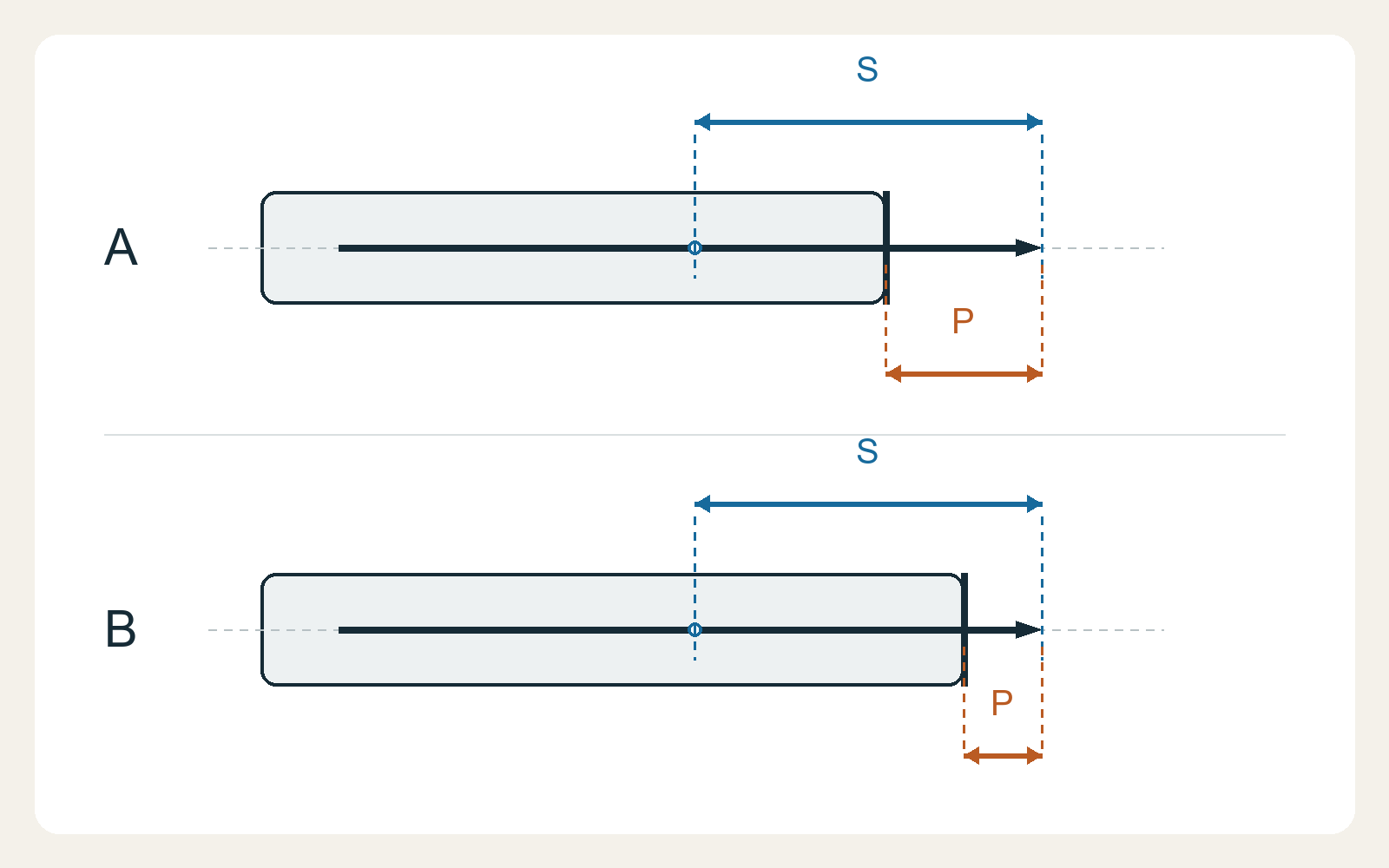
Needle protrusion is the portion of the tip extending beyond the cartridge nozzle. A useful comparison also fixes the point in the cycle: our drawings use the furthest forward position. A photograph taken at a different instant may show less exposed tip even though the adjustment has not changed.
A long-looking exposed needle therefore does not necessarily mean a long stroke. On some machines, a grip adjustment changes the relationship between the cartridge and needle without altering the drive's fixed stroke. The exact function is model-specific. A part that turns does not, by itself, reveal which dimension it controls.
If a listing says only “adjustable depth”, look for the original term and the manual's illustration. The listing may be referring to mechanical protrusion.
Penetration depth asks a different question
Penetration depth concerns the tip's position relative to the skin surface during application. You cannot read it directly from the stroke specification, and the visible length beyond a nozzle does not certify it. A mechanical reference cannot replace professional assessment when working on a person.
This article does not prescribe an insertion distance or explain how to find one. Its purpose is to catch an incorrect inference before it reaches practice: “my machine has this much travel, so that is how much needle should enter”. The second statement does not follow from the first.
Anatomy and concerns such as ink spreading need their own explanations. Renaming a machine measurement does not resolve those questions or make it possible to diagnose a tattoo from a photograph.
A manual that keeps the entries separate
The English HAWK Pen 2 manual, version 1.0 dated 20 August 2025, provides a concrete example. Its specification table lists a 3.5 mm stroke, needle protrusion and frequency separately. Later sections discuss protrusion and frequency under different headings.
The useful lesson is the separation, not a configuration to copy. The 3.5 mm entry identifies a mechanical characteristic of this model. It is not a recommended penetration depth. Do not transfer it to a different HAWK Pen generation simply because the names look similar.
When saving a specification for study, record the model, variant and manual edition. That makes it easier to distinguish an actual inconsistency from a comparison that accidentally mixes documents for different machines.
Same stroke, different protrusion
Three statements worth questioning
“More stroke means greater penetration” confuses travel with depth. “More needle showing means I increased the stroke” confuses position relative to the nozzle with distance between extremes. “This number guarantees a good line” turns a specification into a promise about a result.
One useful check is to ask what was actually observed. Was it a distance in a manual, a setting on a machine or a documented outcome? Those are different kinds of evidence. A commercial chart assigning a stroke to each technique does not explain every difference between machines either.
This approach need not dismiss a trainer's recommendations. It helps you ask for context: which equipment is being discussed, what each term means and which part of the explanation depends on observations that a specification cannot provide.
A paper exercise before discussing settings
Draw a horizontal line and mark two tip positions, A and B. Add an independent mark for the nozzle. Use one colour for the distance between A and B and another for the distance from the nozzle to B. You do not need millimetre values or a realistic cartridge drawing.
Move only the nozzle mark. Write down which distance changed and which stayed the same. Then return to the original drawing and change the separation between A and B: you have altered a different variable. The exercise makes reference points visible; it does not simulate tissue behaviour.
Take the sketch and the manual into a learning conversation. “Does this control change the drive travel or the cartridge's relative position?” is a more informative question than asking how much needle to hang without first identifying the equipment.
A useful habit for your apprenticeship
Before interpreting an adjustment, finish three sentences: “this value measures…”, “it is measured from…” and “I found it in this manual…”. If you cannot finish one, some information is still missing. Filling that gap is more useful than hoping a machine with a larger number will explain the problem.
Practice material can help you document how a setup behaves, but its results do not establish a valid depth for working on a person. Keep that distinction in your notes.
The point to retain is simple: stroke, hang and penetration are not interchangeable. Understanding their reference points improves the questions you ask during training; it does not replace supervised practical training.
Sources and editorial notes
- Cheyenne — HAWK Pen 2, manual EN v1.0 (20/08/2025)
- FK Irons — A Comprehensive Guide On Tattoo Machine Stroke
- Audersigt — Tattoomaschinen-Hub: Einstellungen richtig vergleichen
Manufacturer and organiser facts are linked above. Our selection and reading advice expresses TattooXpert’s editorial judgement.
Our editorial methodKEEP EXPLORING.
Tattoo practice skin: what your practice sheet can—and cannot—tell you
A full practice sheet is not always a sign of progress. Learn to assess lines, joins and fills, compare attempts fairly and recognise what does not carry over to real skin.
TattooXpert
Why does tattoo ink spread? Understanding blowout and skin layers
A halo outside a tattoo line is not the same as healing or gradual ageing. Learn what blowout means, where pigment sits and what to observe before drawing conclusions.
TattooXpert