
Geometric tattoos: build rhythm without forgetting the body
Learn to read pattern, symmetry and composition in real geometric tattoos, with researched references and a practical drawing exercise for beginners.
You draw a clean shape, duplicate it a few times and everything looks convincing. Then you place the design inside an outline of an arm. The centre seems to vanish, or too many pointed shapes gather at one end. This is where composition becomes the interesting part.
When studying geometric tattoos, look at the relationships between shapes, spacing and direction. A useful question for a beginner is what rule holds the piece together, and what happens when that rule meets a body. Two real tattoos and a drawing exercise will help you practise looking beyond the individual triangles.
What to look for before adding another shape
Start by finding a unit: a small shape you can recognise more than once. Then follow its path. Do the units run along a band, turn around a centre or change in size? That gives you something specific to discuss, beyond saying that you like the pattern.
Try drawing four diamonds of your own. Space them evenly, then leave a much larger gap between the third and fourth. The shapes remain identical, but you have introduced a pause. Now turn just one diamond: you have an exception. Make all three versions before choosing your favourite. Regularity and interruption are decisions you can compare, rather than a contest to fill the page.
Give the viewer a place to begin, too. If everything is equally large, dark and dense, explaining what someone should notice first becomes difficult. Consider which element needs attention and which ones can quietly support it.
A history of shapes, without a single invented origin
The Metropolitan Museum of Art identifies geometric decoration as a major family of ornament in Islamic art, describing combinations of circles, squares, stars and polygons. It also points to precedents in late antiquity. That context concerns the works and traditions studied by the museum; it does not establish a direct ancestry for every contemporary geometric tattoo.
When saving a historical reference, record where it comes from and what you are studying: interlacing, a radial arrangement or a change of scale. Avoid assigning a universal spiritual meaning to every star. Similar shapes can appear in different contexts. Investigating a particular work is more useful for your sketchbook than collecting unrelated pictures under a broad label such as “sacred geometry”.
Symmetry is a way of organising attention
In its teaching material, the Met explains repetition and reflection of units in Islamic geometric decoration, alongside the possibility of extending a pattern beyond its frame. These ideas help distinguish a repeating unit from the boundaries chosen to display it.
Separate three decisions in your sketches. Reflection relates two sides across an axis; rotation arranges elements around a centre; repetition along a direction creates a sequence. Try each separately before combining them. If you draw a rosette and then contain it within an elongated outline, you must decide which fragments remain visible at the edges.
You do not have to make every centimetre equally busy. A simple transition can connect two dense areas. To judge the balance, cover each half of the drawing in turn, then look at the whole again. Does the difference look intentional, or have you piled on extra elements to fill an awkward gap? That question gives you a more useful next step than deciding that something is missing.
Keep the earlier version beside the revised one. An extra shape may solve one junction while making the overall arrangement harder to follow.
Reading the butterfly on the cover
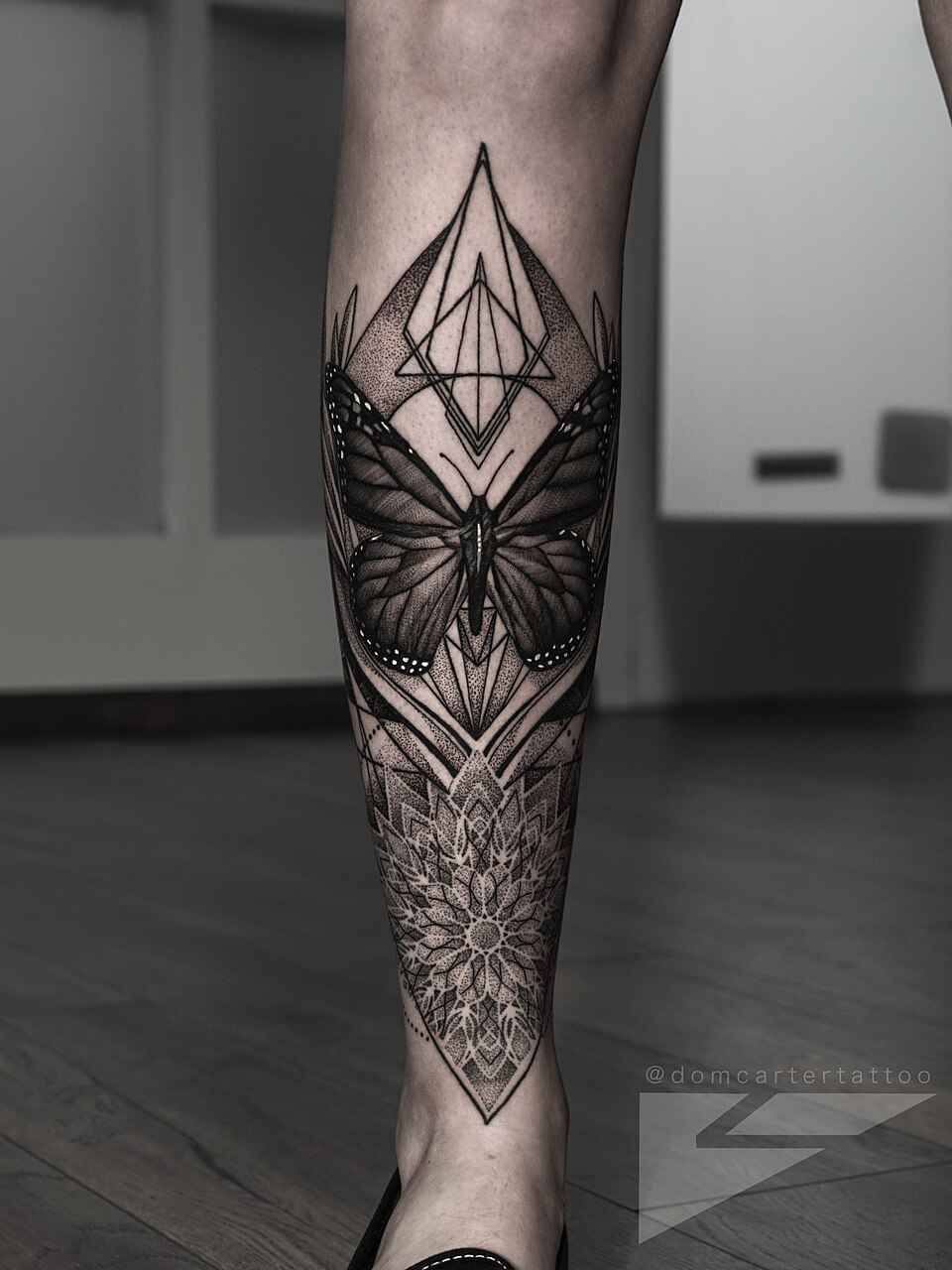
Dom Carter’s photograph shows a butterfly between angular forms and a radial pattern on the lower leg. Dark areas make the wings prominent, while lines, dots and areas of untattooed skin appear around them.
Our reading is that the butterfly provides a recognisable starting point, with the surrounding shapes extending the composition towards the ankle. Look at the relationship between the central axis, the width of the wings and the lower ending. Studying those relationships can help you draw a different subject of your own; reproducing the entire piece is unnecessary.
It also helps to separate your questions. Here, we are looking at how a design is organised. To study how dots build its tones, continue with the dotwork guide. For the relationship between dark areas and untouched skin, turn to the blackwork article. One photograph can support several kinds of observation without needing to fit into a single category.
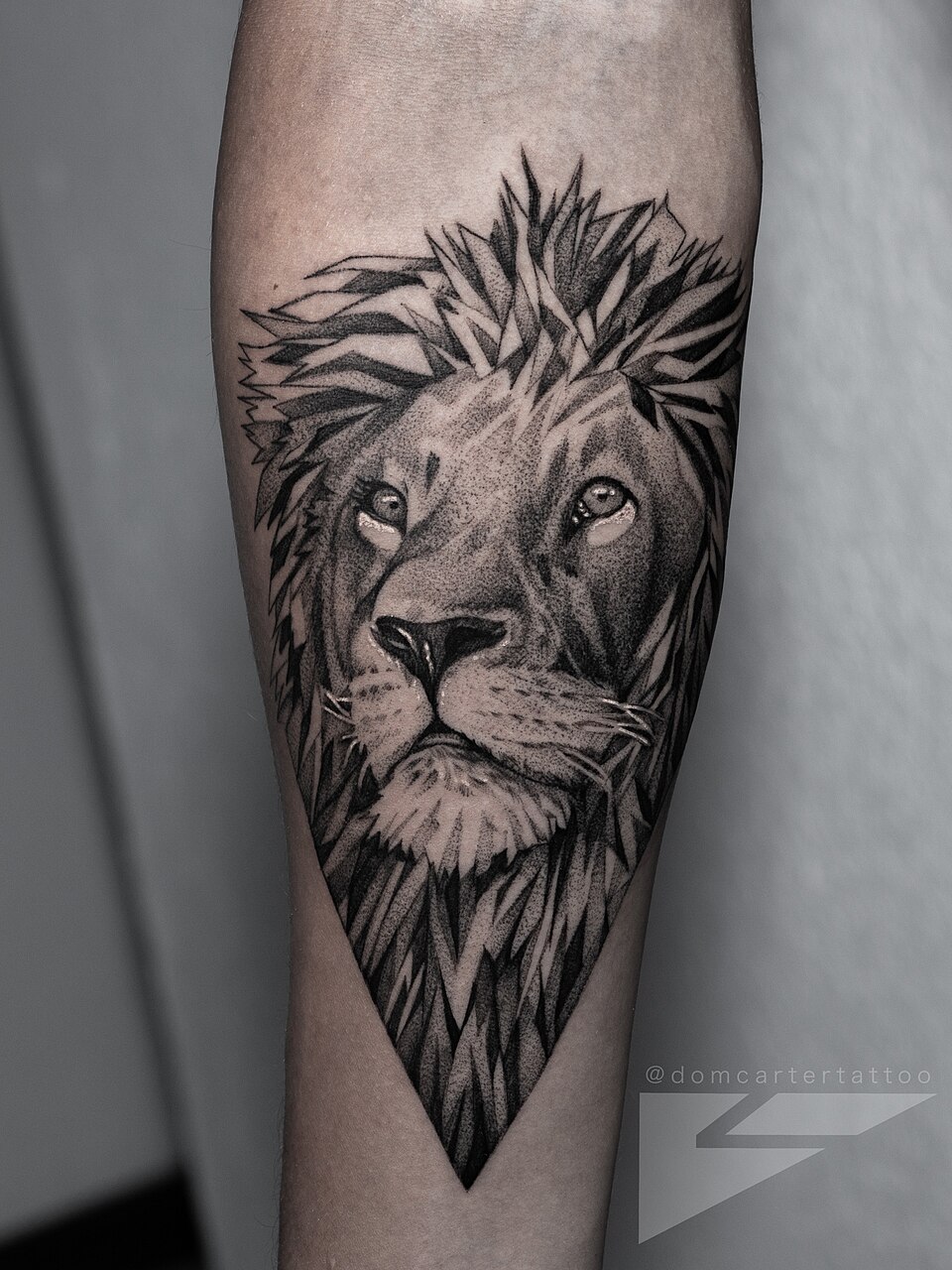
A lion whose mane changes the visual language
The body takes part in the geometry
In “Completing the Circle”, published in August 2025, Chaim Machlev describes a piece whose lines align into a circle when the wearer extends their arms. His account concerns that particular project and its relationship with posture. It provides a documented example of a design conceived for a moving body.
Bring that question into a simple experiment: wrap a drawing of your own around a paper cylinder and turn it. Notice which section faces you, which disappears around the side and where the ends meet. A cylinder does not reproduce human anatomy, but it reveals a problem that a flat sheet hides: you cannot see the whole surface at once.
Photograph three views and choose what should remain recognisable in each. If the composition works from only one angle, decide whether that condition is part of the idea. For a real project, placement and practical suitability need to be developed with a professional. This exercise helps you ask better design questions; it is not a test of readiness to tattoo someone.
A three-version exercise for your sketchbook
Draw a simple unit of your own and use it in three compositions of the same size. Work with pencil, ruler and paper: buying tattoo equipment will not resolve this design exercise. Keep the versions together and record what you changed so that you can compare decisions as well as finished drawings.
- Version A: repeat the unit along a band, keeping the spacing consistent.
- Version B: arrange the same unit around a centre, leaving the central opening visible.
- Version C: adapt one arrangement to an elongated outline and decide where the pattern ends.
- Use a different pencil to mark the place you want the viewer to notice first, then check whether it stands out.
- Try your chosen version around the paper cylinder and keep photographs from several views.
Knowing when to stop adding detail
Before adding detail, explain what holds your drawing together in one sentence: a sequence that opens out, a centre surrounded by units, or a figure connecting two rhythms. If you need to list ten separate motifs to justify it, consider simplifying and trying again.
There is no universal measurement or number of lines that guarantees a successful geometric tattoo. At this stage, aim to demonstrate judgement on paper: a recognisable organisation, deliberate endings and an idea of how the design reads around a volume. A sketch with those decisions worked through gives you much more to discuss and learn from than a page packed with shapes you cannot yet explain.
Sources and editorial notes
- The Met — Geometric Patterns in Islamic Art (2001)
- The Met — Primary Characteristics of Islamic Geometric Decoration
- Dom Carter — Butterfly Geometric Tattoo, Wikimedia Commons
- Dom Carter — Lion / Geometric Tattoo, Wikimedia Commons
- Chaim Machlev — Completing the Circle (8 August 2025)
Manufacturer and organiser facts are linked above. Our selection and reading advice expresses TattooXpert’s editorial judgement.
Our editorial methodKEEP EXPLORING.
Dotwork tattoos: look beyond the dots to understand the shading
Understand dotwork shading, its relationship with blackwork and geometry, and what to study in real tattoo photographs. A paper exercise turns those observations into drawing practice.
TattooXpert
Blackwork tattoos: why negative space matters as much as black ink
Explore blackwork through solid black and negative space, with real references and composition exercises for your sketchbook.
TattooXpert