
Tattoo ink batch numbers, expiry and opening dates: keep them separate
Two matching bottles can have different histories. Learn how to record the batch, printed date and opening date, and link each bottle to useful records.
Identical bottles can have different histories
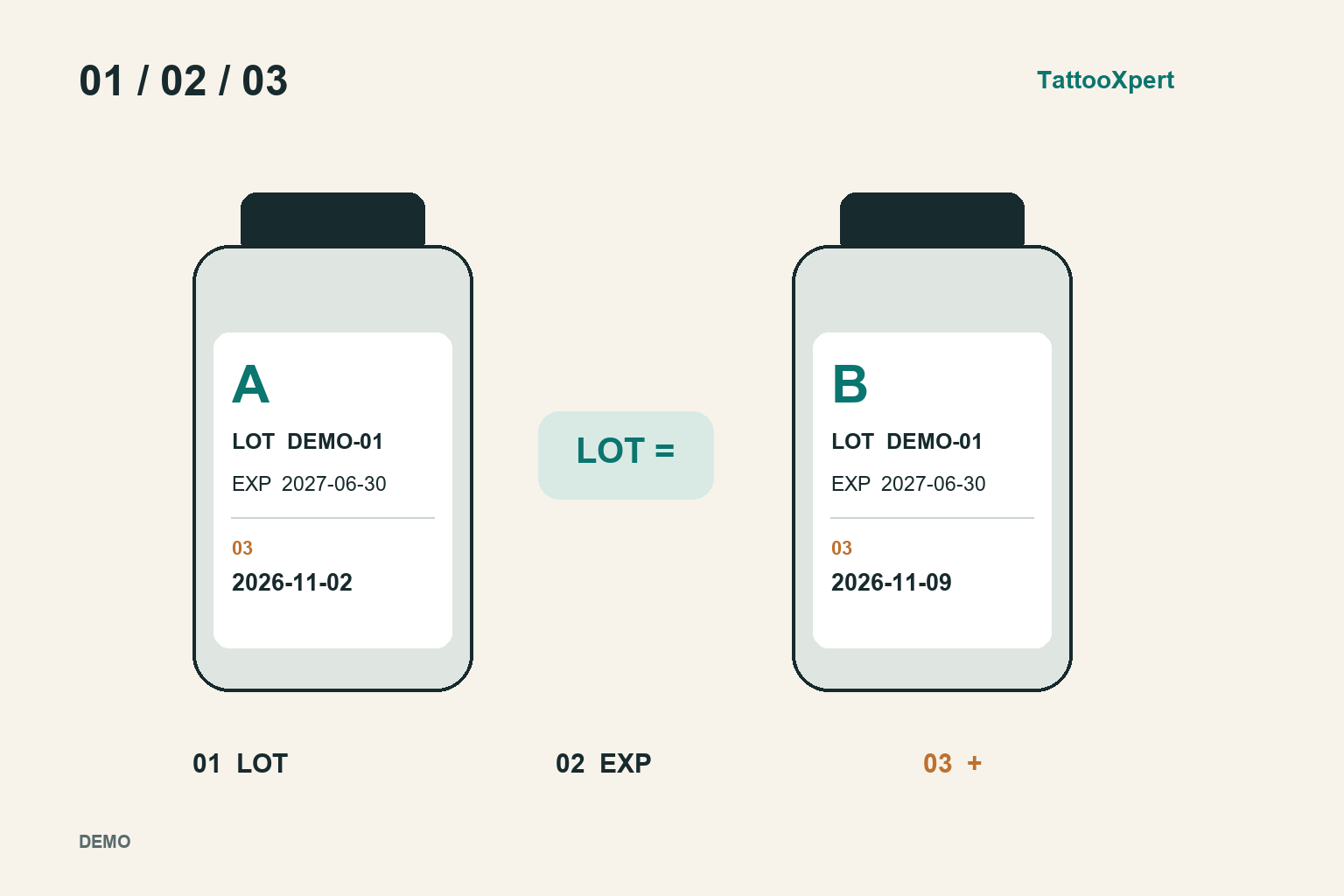
Two bottles of the same black ink sit on your desk. The brand, shade and size match, so they look interchangeable. Yet they might come from different batches, or one might have been open for longer. To understand what is in front of you, separate three records: the batch identifies a production lot; the printed date states the manufacturer's specified date; the opening date records when that particular bottle was first opened.
This distinction is the starting point for tattoo ink traceability. You do not need an elaborate app to begin. You need to be able to reconstruct which product and which bottle were linked to a session. The diagrams here are original illustrations using fictional data, not product photographs or real client records.
A batch number is not a colour name
“Black ink from brand X” roughly identifies a product, but it does not identify a production batch. The lot or batch code adds that reference. It may contain letters, numbers and separators. Copy the entire code, keeping leading zeros and checking characters that resemble one another.
An FDA notice published on May 7, 2025 identifies two Sacred inks by product name, lot code and printed date. We use it here as a documentation example: those details allow a reader to match specific products, rather than simply recognise a brand. This is not a new story from this week.
Keep the brand, range and exact colour name alongside the batch code. An isolated code in a notebook leaves you guessing what it belonged to when you return to it months later.
The bottle date and opening date answer different questions
A printed date does not tell you when a bottle was opened. An opening date does not replace the manufacturer's information. Fusion, for example, explains that its labels carry a best-before date and a space for the opening date. They are separate fields: one comes with the product, while the other records what happened to that bottle in the studio.
Do not automatically carry a shelf-life figure from one brand to another. The World Famous documentation we checked even distinguishes the unopened shelf life of its regular range from that of LIMITLESS. This guide therefore gives no universal number of months. Read the current label and instructions for the actual range you have.
Where the manufacturer specifies a period after opening, recording the opening date lets you apply it alongside the other conditions. Opening a bottle does not reset its printed date or turn an unresolved question into permission to use it.
Three fields, three different questions
Give every date column a precise name. A heading that just says “date” may eventually leave you wondering whether you recorded purchase, receipt or opening. Where necessary, keep the original label wording too, so you know which kind of date the manufacturer declared.
| What to check | What it tells you | What it does not replace |
|---|---|---|
| Batch / lot | The production batch associated with the product. | The brand, range or identity of each bottle. |
| Printed date | The date stated by the manufacturer on the container. | Storage instructions and the period after opening. |
| Opening date | When that particular bottle was opened. | The printed date or an assessment of the product's condition. |
Try this: one batch, two opening dates
Look at bottles A and B in the cover diagram. Both carry the fictional batch DEMO-01 and the fictional printed date 2027-06-30. A was opened on November 2, 2026; B on November 9. In this illustration, 01 means batch, 02 means printed date and 03 means the opening date added by the studio.
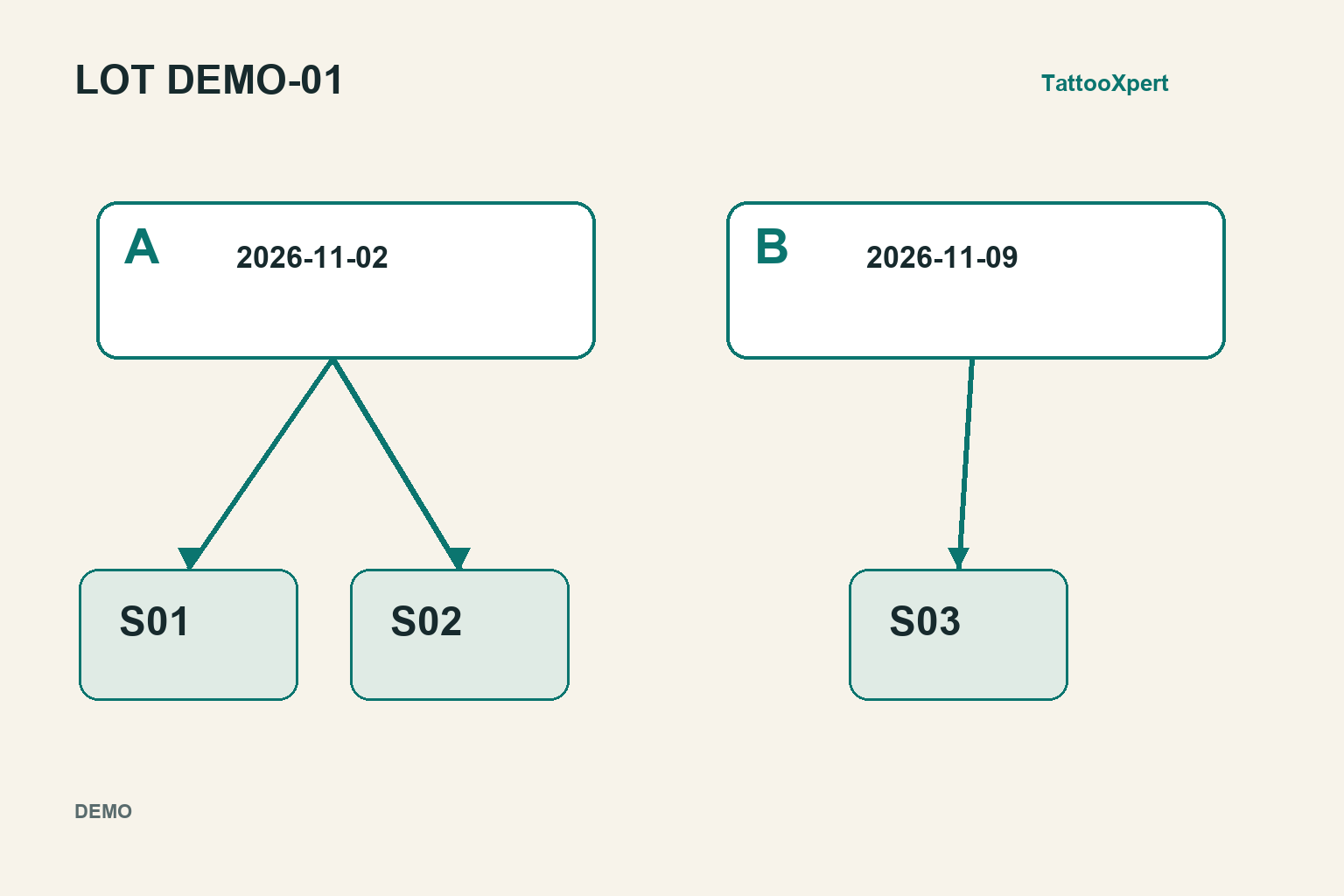
If your spreadsheet has only one row for DEMO-01, where do the two opening dates go? Replacing the first with the second destroys information. One straightforward solution is to assign each bottle an internal identifier, A and B in this exercise, while keeping the manufacturer's batch code in a separate field.
We are not calculating a discard date from these examples. Instructions for a real product would be needed for that. The aim is simpler: check whether your records can distinguish two containers without inventing their histories or changing the code supplied by the manufacturer.
Linking the bottle to the session record
A compact record you can actually retrieve
Our editorial starting point is to keep bottle inventory and session records separate, linking them through an identifier. You do not have to duplicate the whole label in every note, but the connection needs to survive after the bottle has left the shelf. This is an organisational exercise, not a complete legal form.
Try these five fields with a sample container, then check whether another person in the studio understands them in the same way:
- Internal bottle identifier and exact brand, range and colour name.
- Complete batch code and a readable photograph of the original label.
- Printed date as shown, with the date received in a separate field.
- Opening date and the manufacturer instructions checked for that product.
- Linked session references and the record location, with access limited to those who need it.
What a batch-specific notice can teach you
The FDA example shows why a future date printed on a bottle cannot, by itself, rule out an alert concerning that batch. In its May 2025 communication, the agency identifies products with best-before dates in 2027 and advises against using or selling the specified inks.
The documentation lesson is to check product identity, batch and the scope of the notice together. Do not turn a matching brand name into a conclusion about every ink the company makes. Equally, do not dismiss an exact match just because a bottle seems recent. Read the original notice and its instructions.
This US example illustrates how a product is identified. It does not replace notices or requirements applicable in your own country, and it provides no basis for diagnosing a tattoo from a photograph.
If the label is unreadable, do not fill the gap from memory
A zero and the letter O can change a search result. Before transcribing a code, find good light, focus on it and inspect the enlarged photograph. Keep the original image alongside the record. Filing a blurred photograph does not make it readable. If a detail remains unclear, mark it as unresolved and contact the supplier or manufacturer with the available images.
The same applies to a forgotten opening date. An invoice establishes a purchase, not when a bottle was opened. Avoid turning “I think it was Monday” into a date that appears exact. Useful records also make clear what has not yet been established.
The useful test: find the record without retelling the story
Before considering your system finished, run a retrieval exercise. Search for the fictional batch in the diagram and find its two bottles, their opening dates and the linked sessions. Then reverse the route: start at S02 and work back to bottle A's label. If a connection depends on remembering who was working that day, the record needs more information.
This habit also improves learning notes: separating observations from recorded facts helps you avoid attributing something to an ink without evidence. Keep practice-skin records clearly separate from client records. When organising a first tattoo kit, make room for documentation as well as equipment. A well-kept record does not, on its own, prove a product is suitable. It helps you ask better questions using specific references.
How to document and evaluate practice on synthetic skin
What a tattoo starter kit includes—and what still needs organising
Sources and editorial notes
- Fusion Tattoo Ink — Ink Handling and Storage
- World Famous Tattoo Ink — FAQ
- World Famous Tattoo Ink — Revising Consent Forms For Your Studio (8 May 2020)
- FDA — Sacred Tattoo Ink advisory (7 May 2025)
Manufacturer and organiser facts are linked above. Our selection and reading advice expresses TattooXpert’s editorial judgement.
Our editorial methodKEEP EXPLORING.
Tattoo practice skin: what your practice sheet can—and cannot—tell you
A full practice sheet is not always a sign of progress. Learn to assess lines, joins and fills, compare attempts fairly and recognise what does not carry over to real skin.
TattooXpert
Tattoo starter kits: what is included and what you still need
Compare a tattoo starter kit with buying separately: contents, compatibility and learning needs before expanding your equipment.
TattooXpert