
Gus Wagner’s painted tattoo photographs: when the print became part of the artwork
Some photographs associated with Gus Wagner have hand-painted additions on the paper. Two objects from 1903 reveal why a historical tattoo image needs more than a glance.
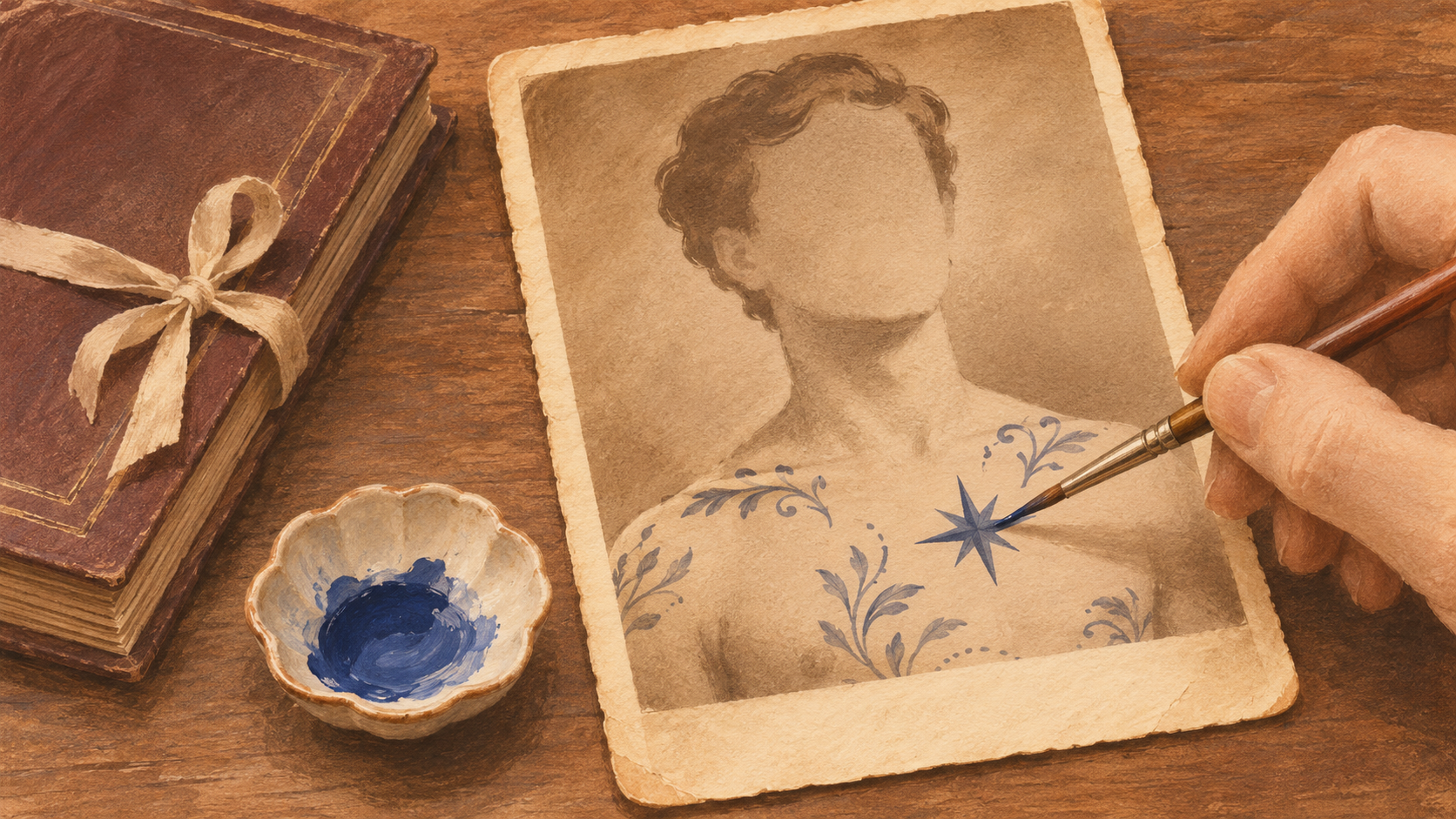
The ink may be on more than one surface
You find an old portrait and zoom in on its tattoos. Before treating the picture as a direct record of skin, ask a less obvious question: did someone also paint on the photograph? For some images associated with Gus Wagner, the documentary descriptions say yes. They identify additions made by hand to the print.
That does not establish that the photographed tattoos never existed. It means the surviving image includes another intervention: paint on paper. Keeping those two things separate changes what the document can teach you. If you are starting out in tattooing and building a reference collection, this is a useful distinction. An image can be valuable without proving every detail that it appears to show.
A tattooer with several public roles
Augustus “Gus” Wagner (1872–1941) worked as a merchant seaman, travelling tattoo artist and tattooed performer. The South Street Seaport Museum preserves material from his career. Historian and curator Steven H. Jaffe also describes those overlapping roles in his account of the American Tattoo exhibition, which he curated in 2000.
That combination invites several ways of looking at the images. One may show a trade at work; another may introduce a performer to an audience. It would be limiting to expect every object to function like a modern tattoo portfolio. Equally, we cannot assign a particular motive to each painted addition without documentary support. Context helps us ask better questions, but it cannot supply a missing answer by itself.
Gus and Maud on a photographic card from 1903
In Deepening the Story, published on 8 January 2026, collections director Martina Caruso discusses a painted photograph of Gus and Maud Wagner acquired by the museum. She dates the image to 1903, when they appeared with Wonderland Shows in Terre Haute, Indiana, and identifies small tattoos painted by hand over the original photograph.
The important evidence is the description of the object. We are not guessing that a dark patch in an online reproduction must be paint: the institution holding the piece identifies the intervention. The date of a photograph, its arrival in a collection and the publication of an article about it are separate facts. Recording them separately prevents a recent article from turning into a supposedly recent event.
Our subject here is the altered paper object. The journal’s separate article on Maud considers her portrait and professional identity.
Another example: Ed Miller’s St George
A Bray & Co. catalogue describes another photograph from 1903: Gus tattooing Ed Miller, whose back carries St George and the dragon. The entry connects it with Chicago and describes painted additions over the original designs. That is information from the object’s catalogue, not a physical examination carried out by TattooXpert.
The distinction matters. Learning that a print has additions does not justify declaring its entire tattoo invented for the camera. Nor should every visible contour be treated as an exact record of the work on skin. Both conclusions would need evidence that an isolated reproduction cannot provide.
We have an object described as altered. Exactly how it looked before the intervention is a separate question. Rather than invent a historical before-and-after comparison, we can explain the difference with an explicitly hypothetical drawing.
Separate the image from the added layer

A scrapbook is not a catalogue of finished tattoos
The museum’s Alan Govenar and Kaleta Doolin collection includes a roughly 400-page Wagner scrapbook containing photographs, clippings, cards, postcards and drawings. This variety can help us study how a career was recorded, provided we first distinguish the kinds of documents involved.
In your own reference folder, a design sheet might interest you for its composition, a card for the way it introduces a name, and a photograph for the scene it shows. Putting all three in a folder called “old tattoos” does not make them all photographs of completed work. Their value depends partly on preserving those differences.
A modest note can be more useful than a confident label. “Photograph with painted additions, according to its catalogue” retains information that “1903 tattoo” may erase. You do not need to solve an artist’s whole biography to describe an individual object responsibly.
Try it with a drawing of your own
To explore the distinction on paper, draw a simple figure with a motif. Keep an unchanged copy and add colour to a second copy only. Put the two together and write down what changed: fill, outline or a newly introduced element. Using your own drawing keeps the exercise independent of permission to reproduce someone else’s work.
Now complete two sentences: “The base motif had…” and “The altered version shows…”. If the distinction is unclear, revise the labels until another person can understand them without a spoken explanation. This does not recreate Wagner’s working method. It practises a present-day skill: describing what you have actually done to an image.
The same clarity helps in a consultation. A design placed over a photograph should be labelled as a proposal or mock-up. If an image is presented as a record of a completed tattoo, adding or repairing the design would change the very thing the viewer expects to be seeing.
Keep the description with the reference
If you save one of these objects for study, retain the catalogue link, the institution or catalogue responsible for the description, and the note about added paint. Keep your own interpretation separate. “I like this silhouette” is your observation. “This line looked exactly like this on skin” requires different evidence.
Access to an image is also different from permission to republish it. Here we link to the sources and use clearly identified original illustrations, without reproducing the historical photographs. The journal’s guides to gathering references and photographing tattoos can take the discussion further: one helps you decide what to study, the other how to show work faithfully.
A small detail that changes the question
The interest of these photographs goes beyond spotting an alteration. They preserve a relationship between tattooing, representation and a physical paper object. Next time you study an old image, start by identifying what kind of thing you are looking at. That pause lets you enjoy its history and use it thoughtfully, without expecting a precision it does not promise.
Sources and editorial notes
- South Street Seaport Museum · Deepening the Story
- Bray & Co. · Painted Cabinet Photograph of Gus Wagner Tattooing St. George and the Dragon
- South Street Seaport Museum · Tattoo Collection
- Steven H. Jaffe · American Tattoo: The Art of Gus Wagner
Manufacturer and organiser facts are linked above. Our selection and reading advice expresses TattooXpert’s editorial judgement.
Our editorial methodKEEP EXPLORING.
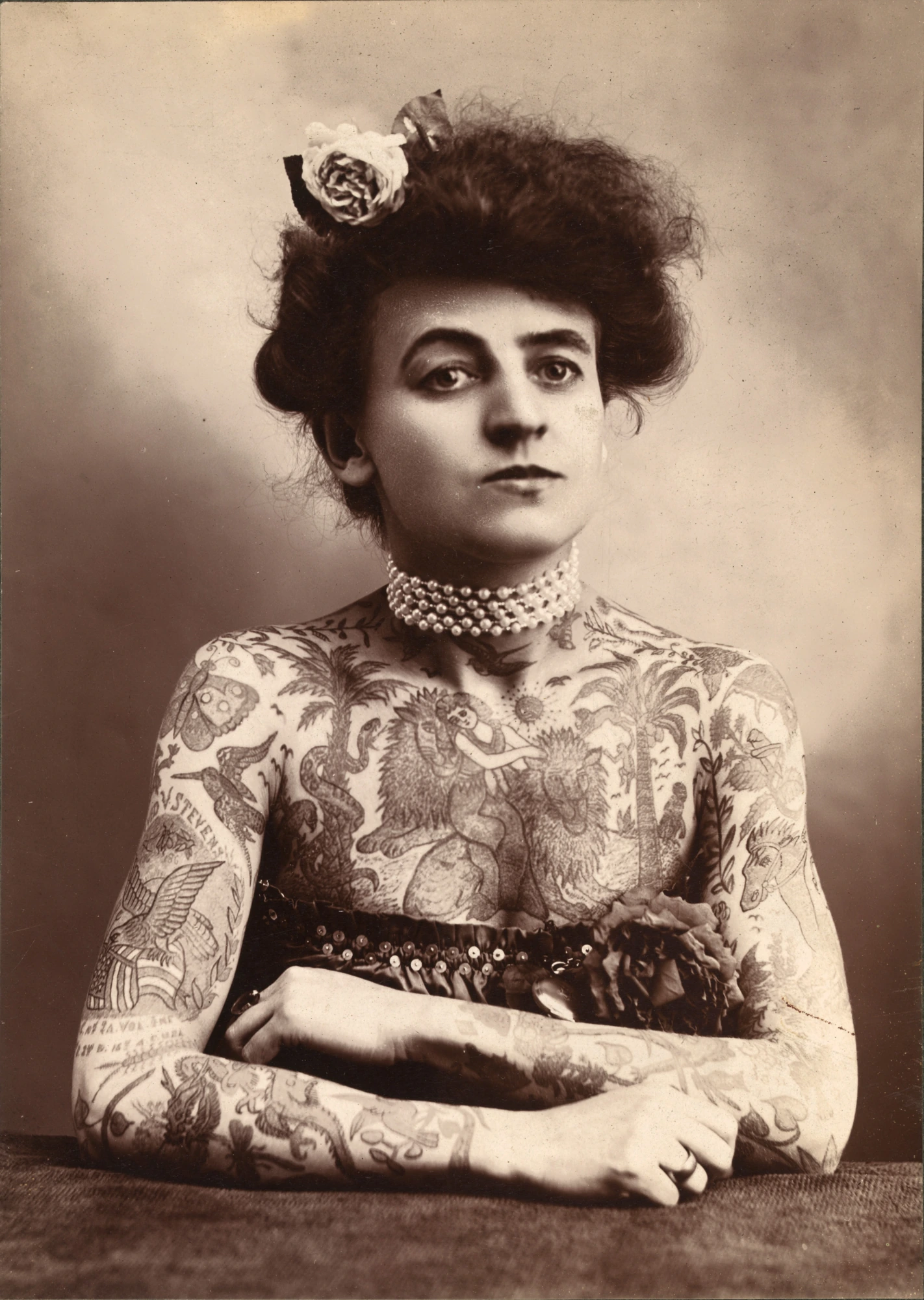
Maud Wagner, tattoo artist: the story beyond the portrait
Meet Maud Wagner beyond the portrait: her profession, historical sources and the questions a photograph cannot answer.
TattooXpert
How to photograph tattoos with your phone without altering the result
Photograph tattoos with your phone: organise the light, check reflections and framing, and keep colour faithful without altering the work.
TattooXpert