
When tattooing was banned in New York: the trade between 1961 and 1997
New York’s ban did not erase tattooing. City records, an archive photograph and Fineline’s history reveal the gap between a rule and the working life of a craft.

A city can ban a practice without making it disappear
It may seem strange to imagine a tattoo studio whose history begins before its city permits the activity again. That is the question behind this story: what happened to the trade while tattooing was banned in New York?
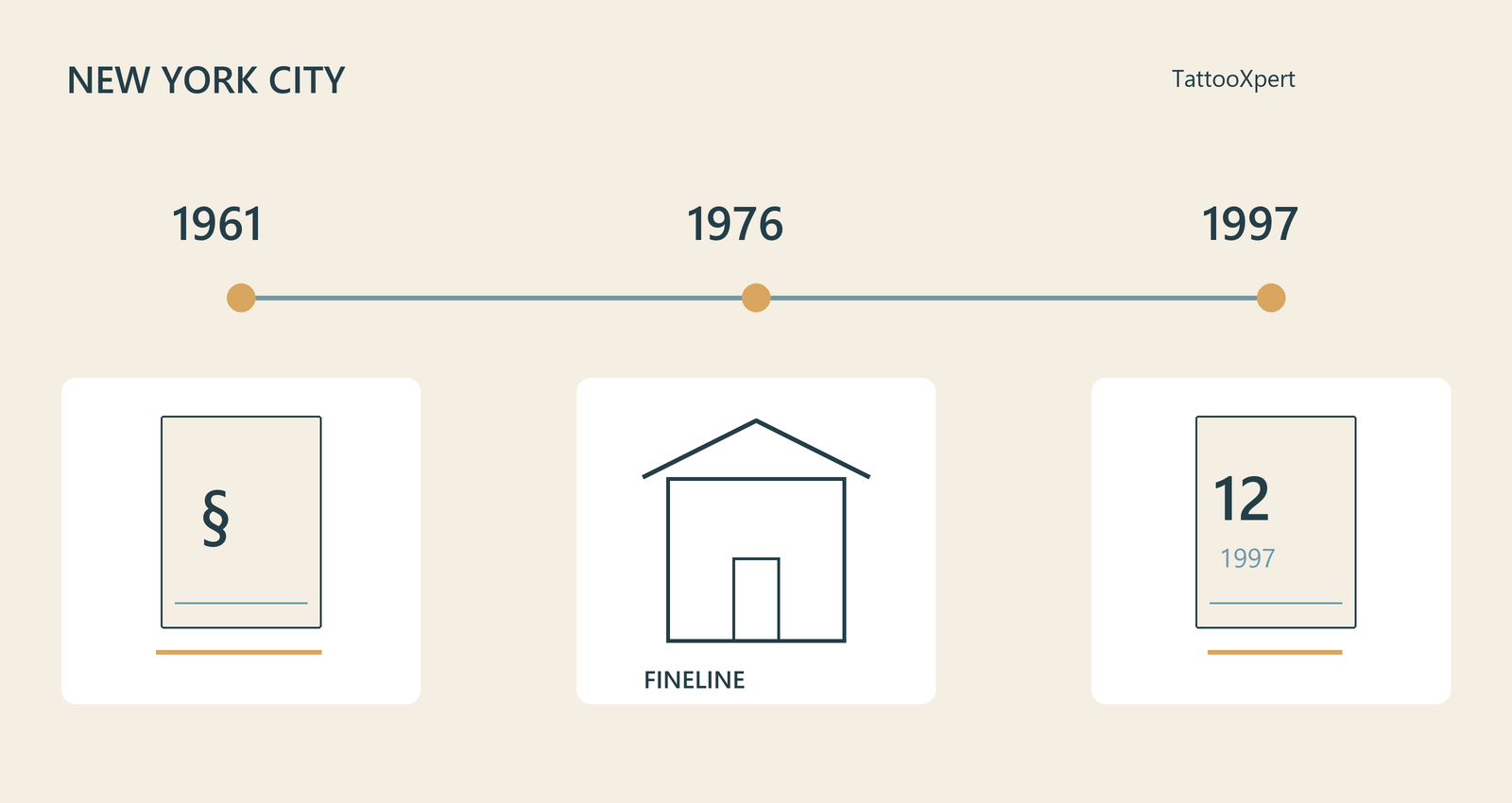
The city maintained the ban from 1961 to 1997. When preparing regulation, the city itself acknowledged that tattooing continued. There is therefore no empty stretch of more than three decades in this history. There is a period that requires us to look at different kinds of evidence.
For an apprentice, this episode broadens the meaning of tradition. A tradition consists of more than machines, drawings and famous names. It also depends on where people can work, how someone finds an artist and which records remain afterwards.
1961: attribute the public-health explanation
A city press release from March 1997 described the ban’s origin as a perceived connection between tattooing and a hepatitis B outbreak. That is the mayor’s office looking back, not an epidemiological conclusion of our own.
The distinction matters. Explaining why an authority defended a measure does not independently prove all the assumptions behind it. Nor does it justify jumping to the opposite conclusion and dismissing every health concern as a pretext. Keeping the attribution allows a tattoo history article to discuss urban policy without making a medical claim.
The geographical boundary matters too: this story concerns New York City. Extending it automatically to the whole state or the entire United States would change the scope of the account.
A Coney Island window before a legend
Brooklyn Public Library holds a 1961 photograph by Irving Herzberg showing a family looking into Brooklyn Blackie Tattooing in Coney Island. It provides a specific reference for tattooing’s presence on the street.
Its interest does not depend on inventing the thoughts of the people pictured. The scene alone cannot tell us whether they wanted tattoos, knew the artist or approved of the business. We can start instead with the information identified by the archive: maker, place, date and subject.
That approach is useful when a historical photograph circulates without its caption. Before treating it as evidence of a golden age or universal marginality, return to its record. The linked source lets you consult the photograph; this article’s illustrations are original diagrams and do not reproduce it.
Fineline: a name inside the years of prohibition
Fineline Tattoo dates its beginnings to 1976 and describes its early years as an underground, appointment-only studio. The history presented by the Bakaty family thus runs through the period of prohibition.
A named example changes how we read the dates. Instead of seeing only a before and an after on a calendar, we encounter a business placing itself within the interval. That cannot tell us how many artists worked this way or establish that everyone shared the same circumstances.
A studio’s published history also deserves to be read as its own account. It can provide an identity and a chronology without requiring us to adopt its marketing superlatives or turn the story into a purchasing recommendation. Attribution preserves the value of the account while making its perspective clear.
What a family memory adds
In a 2016 WNYC interview, Mehai Bakaty recalled his father Mike working from a loft in their home and feeling anxious about telephone calls. This is an attributed recollection reported by Sarah Gonzalez.
The detail introduces something a legal date cannot explain: the everyday uncertainty of working. There is no need to invent a raid, a conversation with customers or a night-time scene to make the episode interesting. The testimony already raises a question: what changes in a profession when being openly visible can become a problem?
The answer is not advice on avoiding oversight. It is an invitation to recognise that the history of a craft includes working conditions. Admiring the continuity of someone’s career does not require romanticising clandestine work or treating it as an apprenticeship model.
1997: from prohibition to regulation
Local Law 12 of 1997 provided for licensing and health oversight of tattooists. Its opening findings acknowledged that artists were still working in the city despite the ban. That contradiction formed part of the legislative argument.
Read the change precisely: regulation does not mean declaring every practice acceptable. Permission to work and professional obligations appear together in the document. Describing a changed framework is therefore more informative than describing freedom without conditions.
This is a historical reading, not a guide to today’s application process. Anyone planning to work now needs to check current requirements for the relevant location. A text from 1997 cannot, on its own, prepare someone to open a studio in 2026. The document answers a question about the past, not every question about the present.
Three milestones, three kinds of evidence
Bring this approach into your own reference archive
Try a short exercise with an image or document from your own city’s history. Divide a page into “recorded”, “my interpretation” and “still to check”. Put identifying details in the first column, your reading in the second and questions the object cannot resolve in the third.
Then write a three-sentence caption that lets someone else locate the source. It need not become an academic paper: the aim is to keep the trail when saving an image. If the maker or date is unknown, preserve that gap. It is more useful than filling it with an appealing story that nobody can verify. A clear reference also makes later corrections possible.
- Identify who produced the record and when.
- Distinguish a rule, a photograph and a later recollection.
- Separate the date of the event from the date of its retelling.
- Check rights before reproducing an image.
A tradition is also preserved by telling it accurately
The lesson for an apprentice is not to imitate an underground studio. It is to recognise the people, places and working conditions left out of a list of styles. A verifiable name and a traceable source help more than an anecdote without a trail.
The same care applies to old flash catalogues, drawings kept by an artist or machine patents. Each record opens one part of the story while leaving other questions unanswered.
When tattoo flash travelled by mail
Sources and editorial notes
- NYC Mayor’s Office — archived remarks, 12 March 1997
- New York City — Local Law 12 of 1997
- Brooklyn Public Library — Want a Tattoo? Fuhgeddaboudit!
- Fineline Tattoo — studio history
- WNYC / Sarah Gonzalez — Mehai Bakaty interview, 19 August 2016
Manufacturer and organiser facts are linked above. Our selection and reading advice expresses TattooXpert’s editorial judgement.
Our editorial methodKEEP EXPLORING.
Jessie Knight: what her drawings reveal about a life in tattooing
A folding flash folder, drawings on both sides of a card and an inscribed book bring Jessie Knight’s working life into focus. Learn to read a tattoo archive without turning it into a legend.
TattooXpert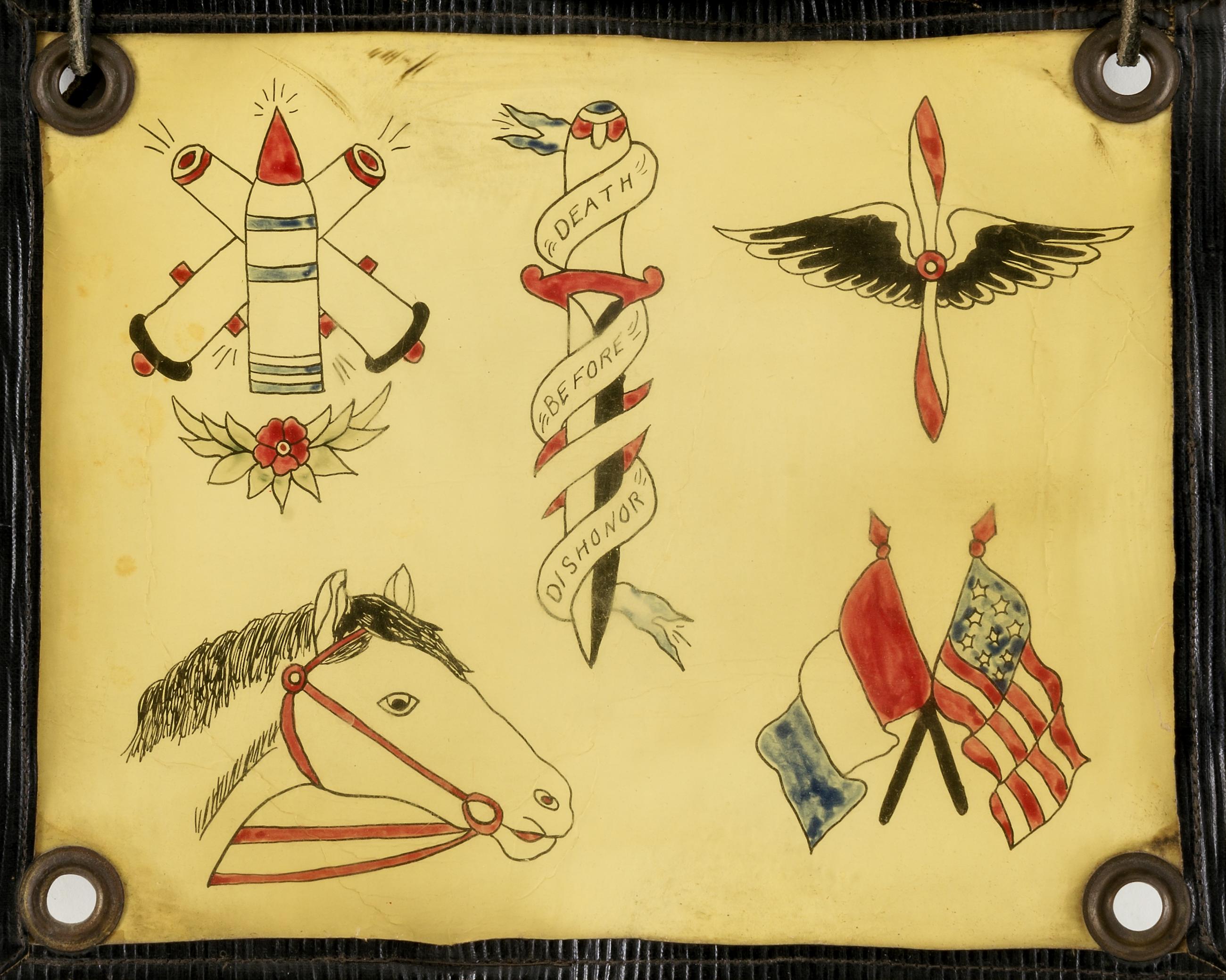
Tattoo flash history: when designs travelled by mail
Before saving designs to a phone, tattooers shared images through sheets and mail-order catalogues. Museum archives reveal how that exchange worked and what a historical sheet can teach a beginner.
TattooXpert