
Tattoo flash history: when designs travelled by mail
Before saving designs to a phone, tattooers shared images through sheets and mail-order catalogues. Museum archives reveal how that exchange worked and what a historical sheet can teach a beginner.
The same rose in two cities: how did it get there?
You open an old flash sheet and recognise a dagger, eagle or rose that could belong on a studio wall today. Tattoo flash history is partly the story of that journey. Predrawn designs were shown to customers, but they also circulated between practitioners through sheets, books and mail-order catalogues. An image could travel without its maker following the same route.
Collections at New York Historical and The Henry Ford document parts of this exchange in the United States from the late nineteenth century into the early twentieth. They do not explain the origin of every tattoo or represent every tattoo tradition. They do offer a useful perspective when you are learning to draw: a flash sheet can be a visual proposal, a working object and a fragment of a shared history at the same time.
A catalogue carried drawings as well as equipment
New York Historical describes flash as sheets of prepared designs displayed in portfolios or on studio walls. In his 2013 article, Joe Festa draws on Albert Parry's 1933 book to explain how mail-order catalogues distributed designs alongside tattoo supplies. That is the basis of the account: a museum interpretation referencing the book, rather than a present-day interview with those artists.
Providence Public Library's Tattoo Ephemera Collection adds another layer. It holds advertisements, promotional material, instructions and catalogues dated between 1881 and 1943. Its finding aid connects the transmission of the craft with learning between practitioners and the circulation of guides and equipment. Drawings travelled within a business and a network of learning relationships.
This changes the questions worth asking of a page. Beyond identifying the designs on offer, consider who distributed it, whom it addressed and what other material accompanied the images.
Percy Waters: the sketch was not necessarily the final version
Percy Waters provides a way into that process without having to invent a scene inside his workshop. The Henry Ford holds material associated with the tattooer, who ran studios and a mail-order supply business in Detroit approximately between 1918 and 1939. The collection article describes stencils, reproduced flash, hand-coloured work and an unpublished manuscript called Skin Deep.
It also discusses a sketchbook from around 1925 containing 37 pages of pen and watercolour drawings. Curator Kristen Gallerneaux distinguishes these working ideas from more refined versions prepared for display as flash. That distinction matters: a surviving drawing does not establish that it was offered exactly as seen, at that size or in those colours.
The archive reveals stages and different kinds of objects, rather than a complete sequence for every design. Nor does it make every similar-looking historical sheet a work by Waters.
Three objects worth telling apart
Start by identifying the kind of reproduction in front of you. These are questions for reading an object, rather than fixed categories that every archive must use.
| What to check | What it helps you study | What it cannot prove on its own |
|---|---|---|
| Sketch or sketchbook | Visible experiments, changes and drawing decisions. | That each design was sold or actually tattooed. |
| Flash sheet | A selection of designs presented together. | The maker's identity if the record does not establish it. |
| Catalogue page | How designs or supplies were advertised and arranged. | Order numbers, buyers' identities or the results they achieved. |
A sheet worth slowing down for
What the gaps between designs can teach you
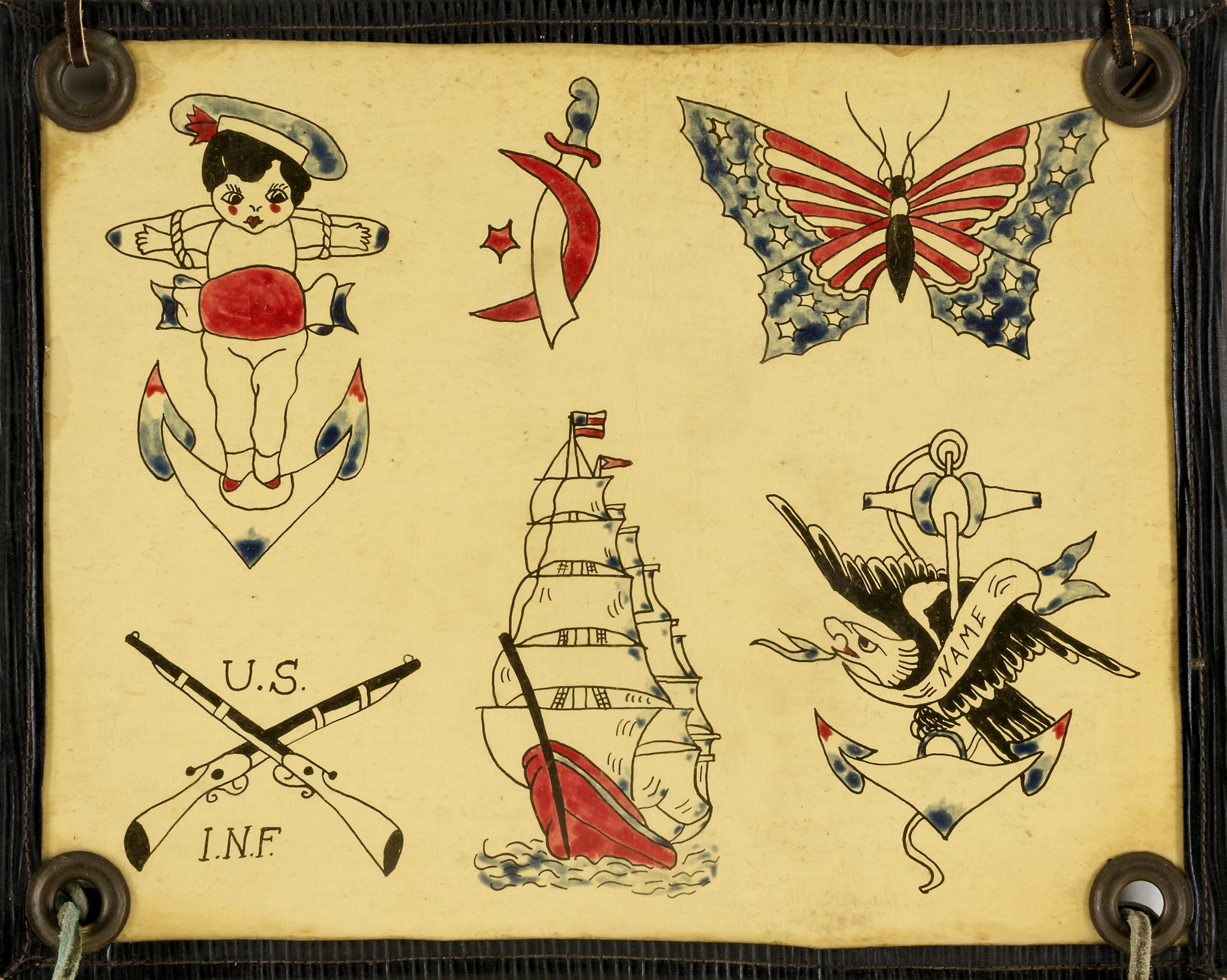
Try looking at the open spaces first, before concentrating on the subject of each drawing. The ship occupies a tall shape, the butterfly spreads sideways, and the eagle and anchor combine several elements into one silhouette. Each design retains its own area and can be recognised before you read the details. That arrangement suggests a useful beginner's drawing question: can each proposal be understood without the neighbouring design getting in its way?
Now look at the ribbon marked NAME. It suggests space intended for a name, but the image does not identify a customer or establish that this version reached someone's skin. You can analyse the ribbon's graphic role without inventing a personal story for it.
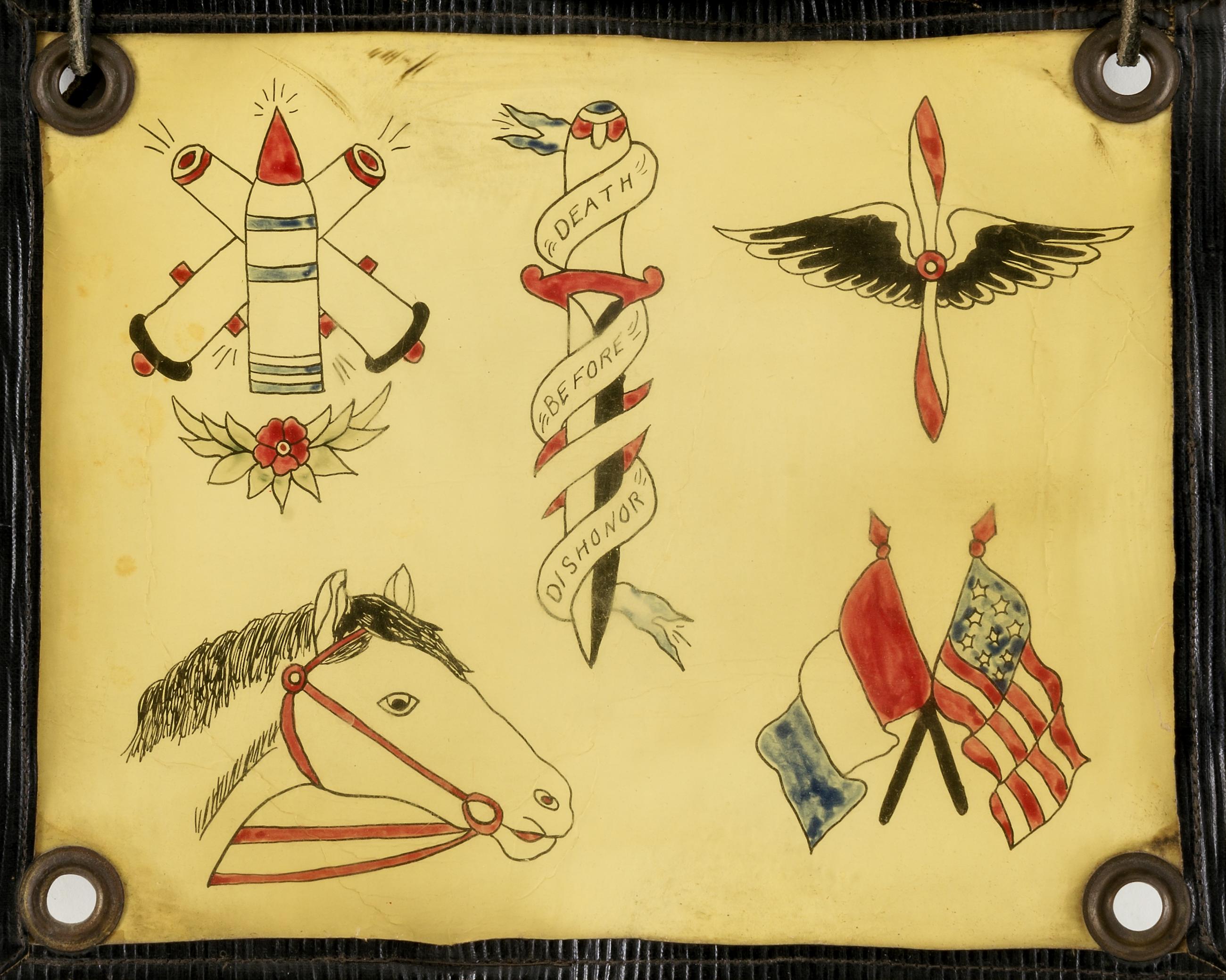
The cover image offers another comparison: the dagger develops vertically while the horse's head makes a broader shape. You need not reproduce either to learn from how they occupy space. Our first flash sheet guide takes that observation further through selection and composition.
Archives leave some questions unanswered
A surviving page can be revealing while still leaving substantial gaps. “Twentieth century” covers a long period; “unidentified artist” states a limit to the available knowledge. It is not an invitation to attach a familiar name. A resemblance between two eagles does not, by itself, establish who copied whom.
Providence describes a predominantly North American collection with some material from elsewhere. Keep that scope when telling the story: one institution's holdings are not a sample of tattooing across the whole world. Likewise, a catalogue records an offer, not a complete account of demand.
When taking notes, use three columns: what you can see, what the record says and what remains a question. “There is a ribbon” belongs in the first. “Unidentified artist” goes in the second. “Who commissioned this design?” stays in the third until another source can answer it.
Circulation does not make every design free to reuse
The exchange of historical flash helps explain a visual tradition; it is not enough to decide how a contemporary image may be reused. The two reproductions here have a specific permission: the Smithsonian marks them CC0. That applies to these images, rather than everything labelled “old school”.
In your reference notes, keep the artist's name when known, the institution, the object record and the licence. Label a study as a study. When working from a living artist's reference, check their terms or ask before treating it as available for reproduction. Keeping track of where an image came from also helps you distinguish what you have studied from a composition you developed yourself.
An archive exercise before returning to the pencil
Use one sketchbook page to investigate a single flash sheet. The aim is to return to drawing with better questions, rather than fill the gaps with imagination.
- Record the institution, accession number, attribution exactly as given and the date with its stated level of precision.
- Describe two visible choices: relative sizes, the direction of designs or the relationship between outline and colour.
- Ask a question the image cannot answer, then look for a second source to investigate it.
- Draw your own composition using a different subject and note the principle of arrangement you studied.
Follow the paper to understand the tradition
The next time an old rose looks familiar, you can go beyond recognising a style. Find the complete sheet, distinguish a working drawing from a catalogue and check who holds the object. That process restores some of the context of work, circulation and learning around the design.
For your own drawing, the useful outcome is not a stockpile of interchangeable motifs. It is learning to observe how a proposal is arranged, presented and passed on. American traditional drawing becomes more interesting from there: decisions about line, black and colour can be studied through specific references without reducing an entire history to a list of symbols.
Sources and editorial notes
- New York Historical · Joe Festa, A Short, Incomplete History of American Traditional Tattooing (2013)
- The Henry Ford · Kristen Gallerneaux, An Artist with the Needles (2014)
- Providence Public Library · Tattoo Ephemera Collection, finding aid
- Smithsonian American Art Museum · Tattoo Flash, 1998.84.50F
- Smithsonian American Art Museum · Tattoo Flash, 1998.84.50A
Manufacturer and organiser facts are linked above. Our selection and reading advice expresses TattooXpert’s editorial judgement.
Our editorial methodKEEP EXPLORING.
American traditional tattoos: what drawing a rose can teach you
Study American traditional tattoo drawing through silhouette, black and colour, using a rose to explore clear composition.
TattooXpert
How to make your first tattoo flash sheet with a clear idea
Design your first tattoo flash sheet with a shared idea, thumbnails, selection and a layout that makes the whole page work.
TattooXpert