
Paper for tattoo flash: why paper weight isn't the whole answer
Choose paper for sketches, ink drawings and watercolour flash by understanding surface and weight. A small sample test can help you buy materials with a clear purpose.
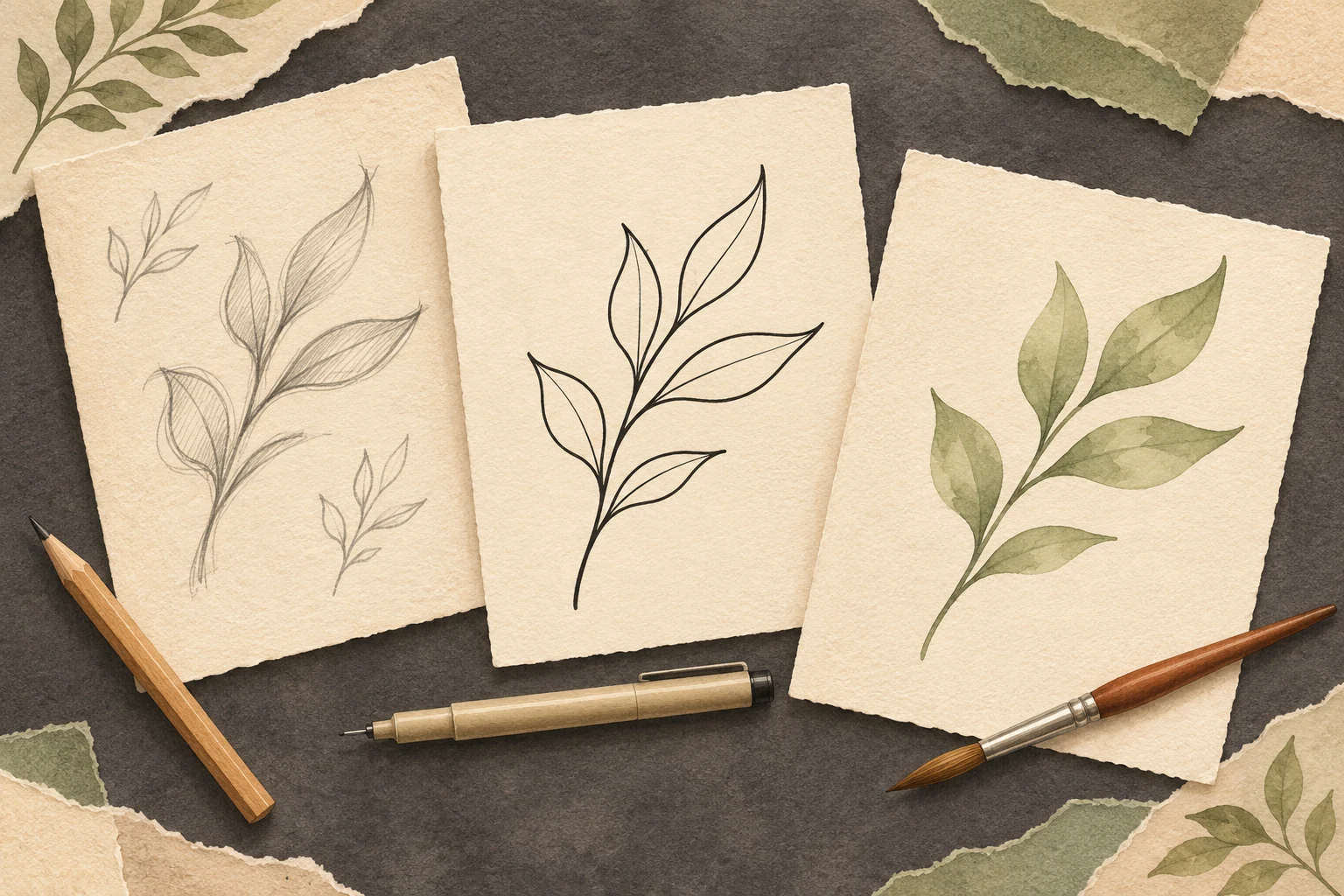
Start with the drawing you want to finish
You have worked out a design, inked its outline and started adding colour. Suddenly the sheet is behaving differently from what you expected. The tempting answer is to buy something more professional. The useful question comes first: are you making rough sketches, a finished ink drawing or a flash sheet painted with watercolour?
To choose paper for tattoo flash, start with the medium and the finish you want. Then compare surface, paper weight and format. A higher number on the cover cannot answer all three questions, and one sketchbook does not have to handle every stage of your work.
This guide concerns paper for developing drawings and presenting designs, rather than stencil transfer paper. The aim is to understand why a particular sheet suits a task. A tattoo-related label is not a substitute for knowing how you intend to use it.
Give rough sketches and finished sheets different jobs
Imagine a rose with three possible arrangements of petals and leaves. While you are deciding which composition works, you want room to experiment without worrying about the cost of every revision. Begin with paper you already own and check whether it works with your pencil and the corrections you make.
For a finished sheet, the question changes. Do you want a clean ink outline, visible texture through a pencil drawing or a surface for working with water? Write that purpose down before browsing brands. Black outlines with two colour washes is a more useful brief than good drawing paper.
Decide on the finished size as well. A small design that sits comfortably in a sketchbook does not tell you how to arrange a whole flash sheet. Work out margins and space between designs before cutting paper intended for presentation.
What gsm actually tells you
Paper weight in grams per square metre describes mass per unit area: 300 g/m² means that one square metre of the paper weighs 300 grams. It is not a direct measurement of thickness. Canson makes that distinction in its watercolour guide, treating thickness as a separate measurement.
Comparing the numbers on two pads therefore leaves important questions unanswered. Gsm does not describe surface texture or establish that a paper is designed for wet media. The intended medium and the surface finish still matter.
Canson recommends 300 g/m² as a general starting point for watercolour. That does not make it a universal minimum for every flash drawing, or a promise that a sheet will stay flat however much water you apply. It is advice for a particular use, rather than a ranking in which heavier paper is automatically better.
Smooth and vellum Bristol are different surfaces
Strathmore distinguishes smooth Bristol from vellum Bristol. Smooth has very little tooth and is intended for uses including detailed pen, ink and marker work. Vellum has a more textured surface suited to dry media such as graphite and coloured pencil.
In this context, vellum names a surface finish; it does not mean that the sheet is translucent tracing paper. Bristol alone is not a complete description of the texture. The particular version of the pad matters.
Canson's drawing-paper guide also links surface choice to the tool and points to smooth paper for pen and ink. Texture is not inherently a fault: it can be part of the pencil effect you want. These are manufacturers' material recommendations, not findings from a physical test conducted by TattooXpert.
Painting flash? Check the intended use with water
Canson's guide describes smooth hot-pressed, cold-pressed and rough watercolour surfaces. Sharing a paper weight does not make these finishes identical. A smooth sheet and a textured sheet can have the same mass per square metre.
Some artists deliberately choose a smooth surface. In his traditional flash tutorial, André Silva describes a preference for hot-pressed 300 g/m² watercolour paper. That is one artist's working choice, not a rule binding everyone who paints flash.
The practical point is to look for a paper whose description includes the wet medium you intend to use, then check its finish. The word Bristol on the cover is not enough. General recommendations about a paper family cannot replace the information for the specific version in front of you.
Three tasks, three things to prioritise
Use this comparison to decide which sample to try. It is not a brand ranking or a demand to buy three pads. One paper may suit several jobs if your own sample confirms it.
| What to check | What to prioritise | What to check on a sample |
|---|---|---|
| Sketches and composition | Comfortable drawing and correction. | How the surface responds to the pencil and eraser you actually use. |
| Finished ink drawing | A surface that suits your nib or pen and the intended finish. | Continuity of the outline, the edges of the ink and the back of the sheet. |
| Watercolour flash | Paper intended for wet media, with the texture you want. | Its response to the planned wash and its appearance after drying. |
Make a sample card before buying more
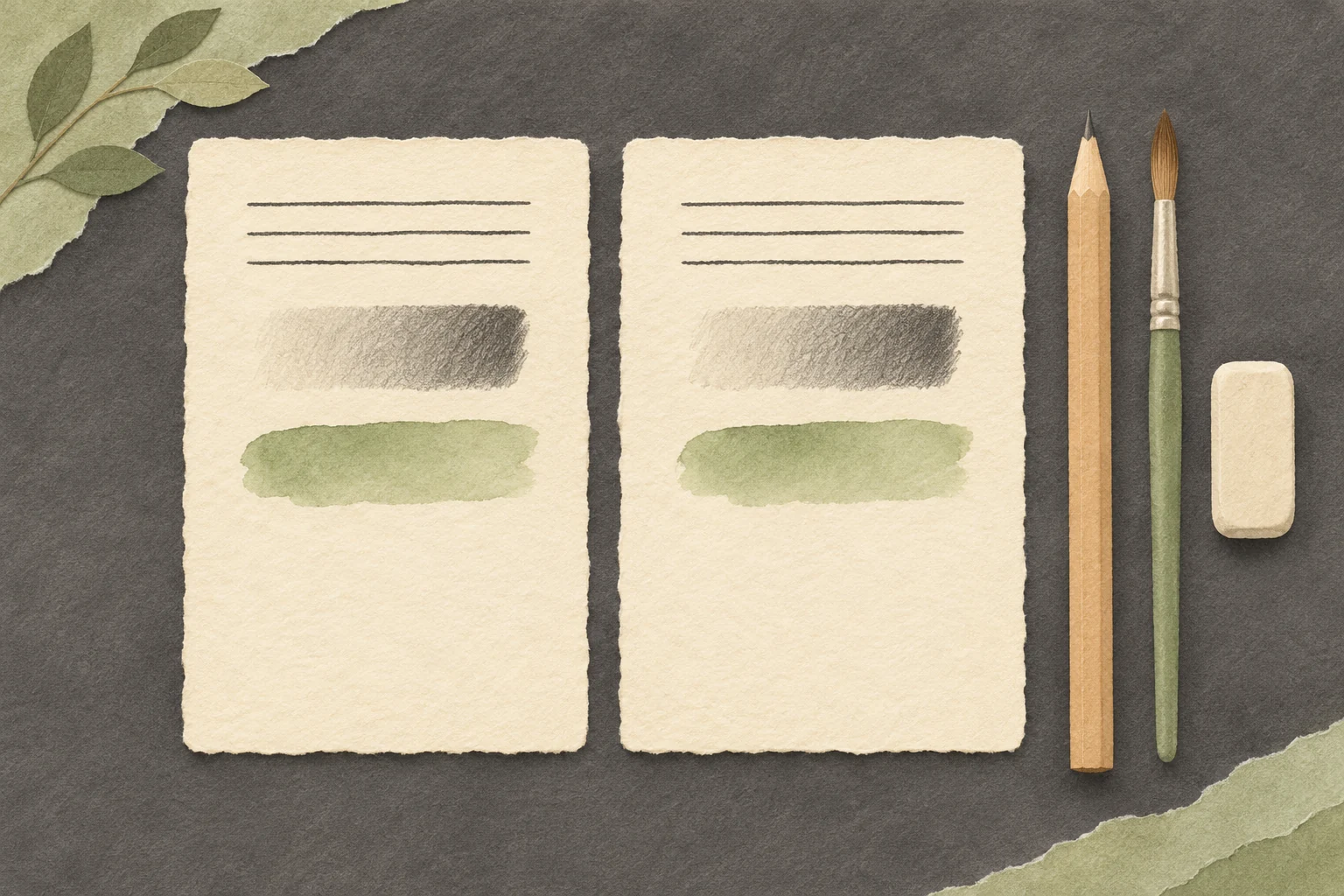
Check the combination before blaming your linework
If a pen behaves unexpectedly, try that same pen on a familiar sample first. If the problem only appears after adding water, test that sequence on an offcut. Choosing watercolour paper does not, by itself, establish that the ink underneath a wash is waterproof.
This check is not a drawing-skills assessment. It helps separate material decisions from questions about hand movement and composition. Once you find a combination that behaves predictably for you, keep it for several drawings. That gives you a clearer baseline for noticing what changes in your work, without replacing several materials every time something feels difficult.
Buy a format you will actually use
Before buying a large pad, think about where you draw and how you will keep the work. A sketchbook may fit ideas you carry around with you; a loose sheet may suit a finished presentation without a binding. Check the usable dimensions, margins and how sheets come away from the pad.
If you intend to photograph or scan the drawing, keep a reference sample too. It can help you distinguish texture belonging to the original from a shadow introduced during capture. Selecting paper and making a digital image are connected decisions, but they require different checks.
A small purchase you can evaluate is a sensible starting point compared with collecting formats without a defined task. Find a combination for one job first. Expand your materials when the next drawing gives you a reason to do so.
The decision worth remembering
Define the medium, check the surface and try your own tools. Paper weight helps describe a sheet; your sample helps decide whether it suits that drawing. You do not need the heaviest paper. You need to understand the paper you plan to use.
Sources and editorial notes
- Canson · Select your drawing paper
- Canson · Selecting your watercolor paper
- Strathmore · Bristol smooth and Bristol vellum
- André Silva · How to paint a traditional tattoo flash
Manufacturer and organiser facts are linked above. Our selection and reading advice expresses TattooXpert’s editorial judgement.
Our editorial methodKEEP EXPLORING.
Digitize drawings for your tattoo portfolio without losing the detail
A practical guide to photographing or scanning drawings, preserving subtle marks and preparing files to share. Understand resolution, review filters and check the copy you actually send.
TattooXpert
How to make your first tattoo flash sheet with a clear idea
Design your first tattoo flash sheet with a shared idea, thumbnails, selection and a layout that makes the whole page work.
TattooXpert