
Sutherland Macdonald: the London tattoo artist who thought big
A studio in Turkish baths, a dragon sweeping across a torso and an ambitious advertisement: meet Macdonald through the records and learn to look closely at his work.
A dragon before social media
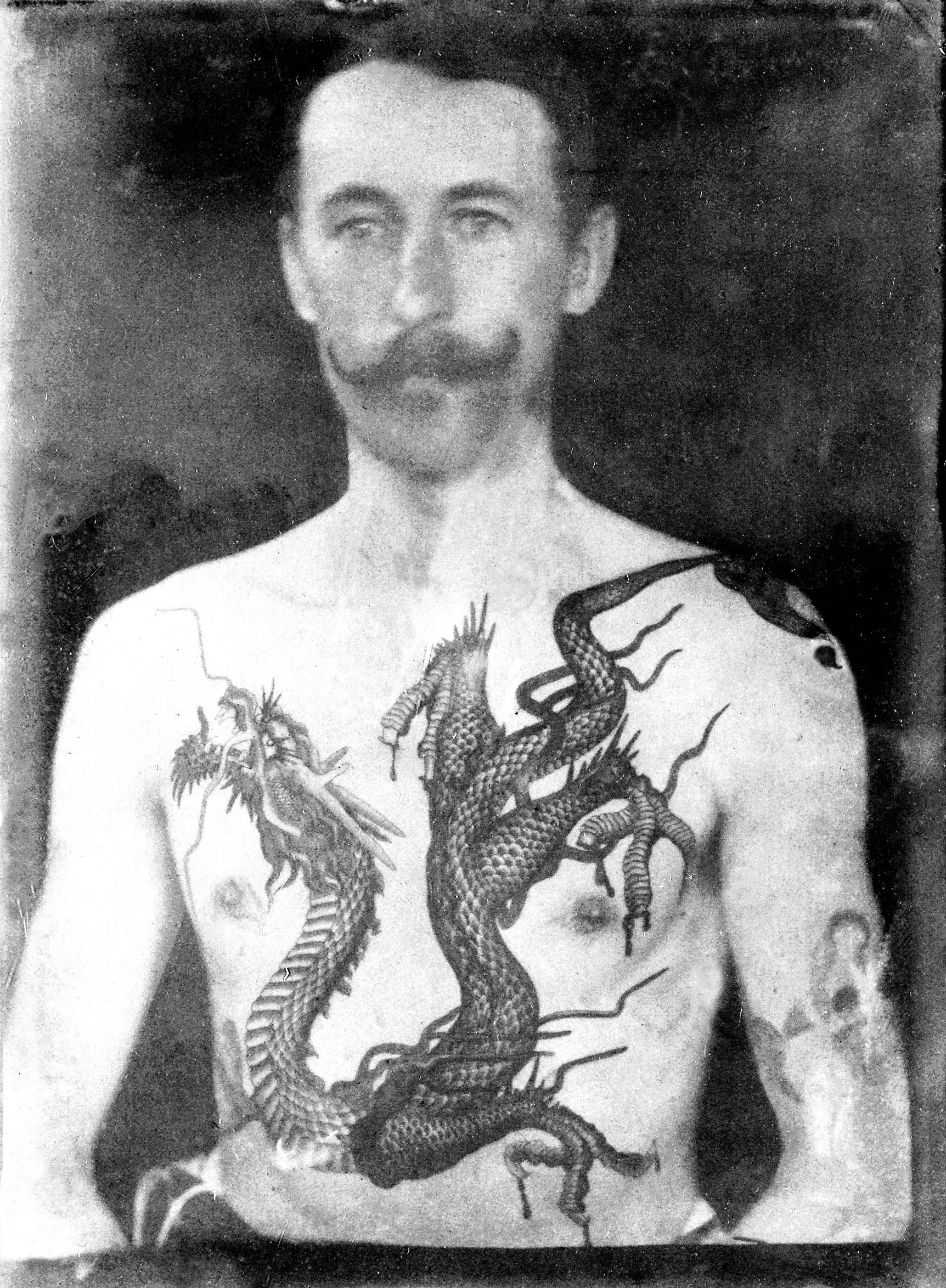
Look at the dragon in the cover photograph. It fills most of a man's torso, curves across his abdomen and carries its head towards his chest. This is hardly a modest Victorian keepsake. The tattoo is a work by Sutherland Macdonald, preserved in a historical photograph, and an inviting starting point for meeting an artist working in late nineteenth-century London.
Macdonald matters for more than his reputation. The records reveal a studio with design albums, ambitious work and carefully considered advertising. For an aspiring tattoo artist, his story offers a chance to look at composition on the body and the way a craft is presented. We do not need to credit him with inventing everything to find his work worth studying.
Jermyn Street: a studio inside the Hammam
In 1897, Gambier Bolton devoted part of Pictures on the Human Skin, published in The Strand Magazine, to Macdonald's small studio at The Hammam in Jermyn Street. He describes a divan, electric lighting, a stove and albums that visitors could browse. It emerges as a place for looking at and choosing pictures as well as having them tattooed.
The same account connects Macdonald's interest in tattooing with the Royal Engineers and his interest in figure and landscape painting. Keep that attribution in mind: this is a contemporary writer's account, not a modern interview. Its particular value is the place it gives drawing and image selection within Macdonald's practice. His career becomes more interesting when it is not reduced to a machine or a roll call of famous clients.
An advertisement that builds a reputation
What the circular is selling
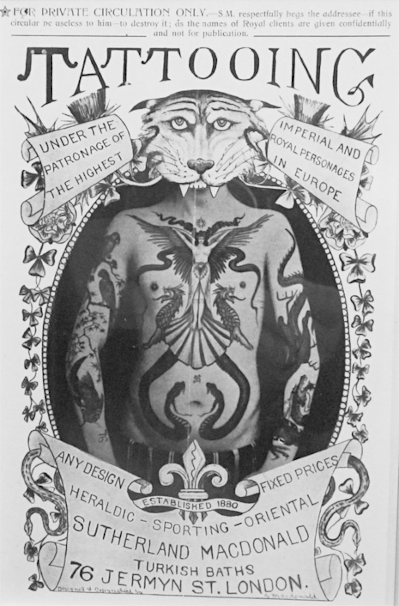
The advertisement shows how the studio wanted to present itself. Tattooing dominates the top; below it, a tiger's head frames a torso while ribbons carry messages about designs and customers. The address at the bottom locates the Turkish baths at 76 Jermyn Street, London. An image of the work, a description of the service and a destination all share the page.
The wording also invokes royal patronage. We can establish that the advertisement makes that claim; the circular alone cannot establish who was tattooed there. That distinction matters when writing history and when assembling a portfolio today. A promotional statement and a record of a particular piece of work perform different jobs. The document is revealing precisely because it puts artwork and promotion side by side.
A large composition needs a readable route
Your eye can enter at the head, travel down the neck towards the abdomen and follow the body as it rises again. The broad curves organise the picture; the scales provide a closer, second reading. Starting with those details risks missing the decision holding everything together: where the animal travels and how much of the body it occupies.
Dark areas sit beside open spaces. In our reading, these gaps help separate limbs, body and outline rather than simply waiting to be filled. This is an observation exercise, not a reconstruction of the artist's private intentions. On paper, try drawing only the main curve and three broad masses without reproducing the dragon. If the sketch still has a readable direction, you have found a compositional idea to explore with a different subject of your own.
Black and white cannot tell the whole story
In 1897, Bolton identified a limitation of the photographs accompanying his article: subtle shading and colour were being lost in reproduction. On page 434, the captions even describe colours that the printed images cannot show. The photograph and its documentation need to be read together.
His warning concerns the images in that article. It does not establish the palette of every later photograph in the archive. With the 1905 dragon, we can study the visible arrangement of light and dark, but we cannot recover its exact colours or judge its healing from this copy. A documentary image preserves information; it does not preserve everything about the original work. Keeping that distinction clear makes the photograph more useful, not less interesting.
Albums, selection and artistic ambition
According to Bolton, Macdonald's albums contained drawings and paintings from varied sources, selected for adaptation into tattoos. The writer even mentions purchasing rights to some pictures. He provides no inventory that would let us attach that account to every surviving work, but he does describe a deliberate selection process extending beyond a single repeated motif.
The report also presents animals, heraldry and figurative subjects. That range helps explain why Macdonald does not fit neatly into one present-day style label. His references and setting were different from ours. Studying him does not require calling every decorative animal neotraditional or treating every dragon as Japanese. Identifying the particular document and the visual relationship we can actually support gives us a better starting point.
Read the praise without turning it into a league table
Bolton praises Macdonald enthusiastically and places different traditions in a hierarchy. Those passages also tell us about the writer's outlook and his era. They are not an objective ranking of tattooing around the world. The report includes historical health claims, too, which are not suitable guidance for present-day practice.
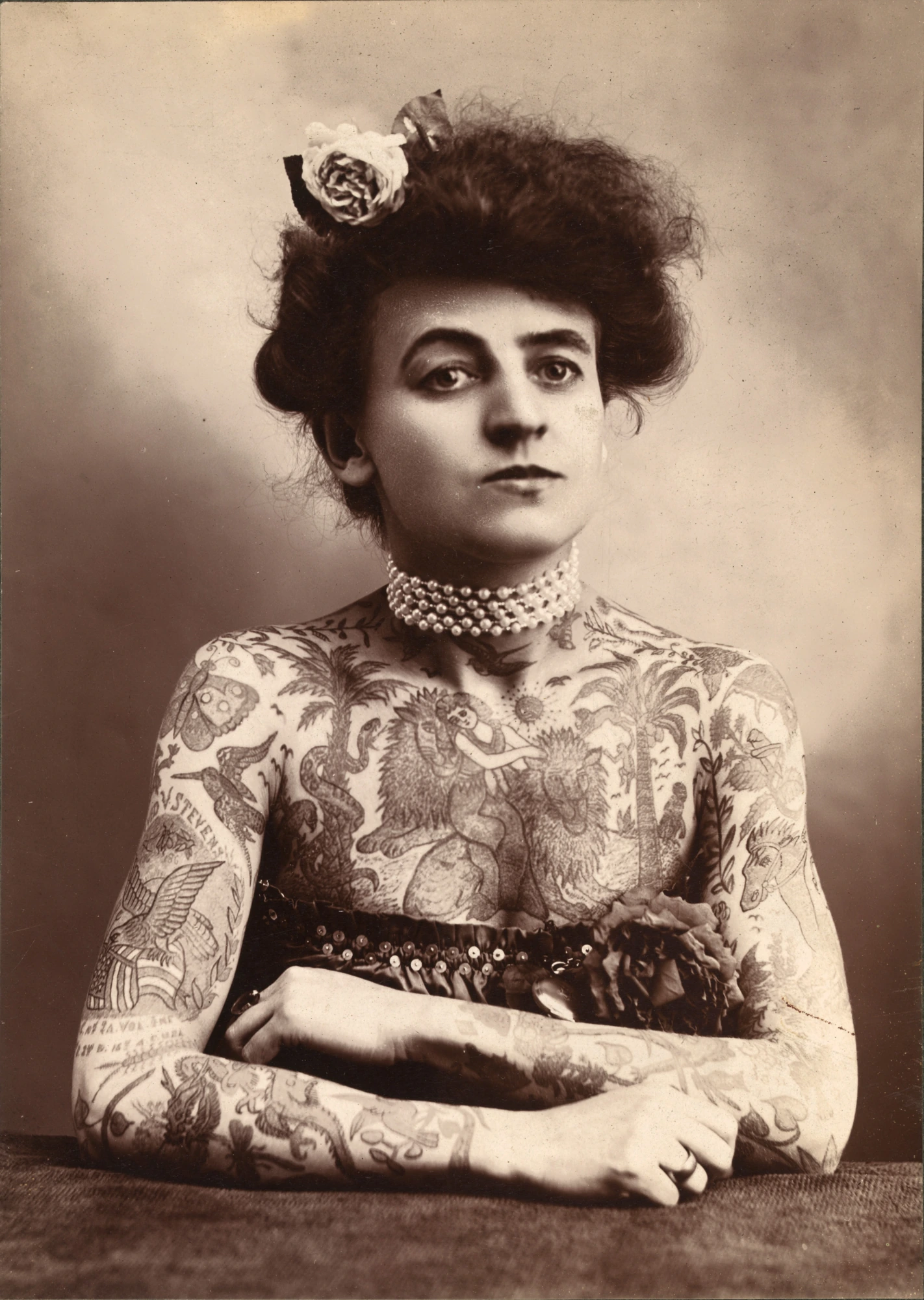
This account therefore separates concrete evidence—the described studio, the images and their records—from superlatives. Tattoo biographies become richer when we preserve those distinctions: who is speaking, what could they observe and what remains unknown? Maud Wagner's portrait offers another way into that relationship between a person, their profession and the images that survive them.
An exercise for your sketchbook
Set aside a page to study the composition, rather than tracing the tattoo to offer it to a client. Keep the reference image and its source alongside your drawing. These four notes turn a historical curiosity into a useful exercise in looking.
- Draw the animal's main direction as a single line. Note where it changes course.
- Reduce the image to three light and dark masses. Check which separations remain readable.
- Separate what you see from what the record tells you: the curve is visible; the date and attribution come from the catalogue.
- Apply one compositional decision to a different original drawing and explain what you changed.
A lesson that still belongs in a studio
Macdonald left images that can stop us in our tracks more than a century later. A torso, a clear visual route and a recognisable presentation are enough to raise questions that remain useful in a studio.
Take one into your next drawing: does the overall shape read first, or is the quantity of detail doing all the work? Studying tattoo history can begin there. An old reference does not prescribe how to work on skin; it offers another way of looking before you design.
Sources and editorial notes
- Gambier Bolton — Pictures on the Human Skin, The Strand Magazine (1897)
- The National Archives — Dragon tattoo, COPY 1/490 (484), 1905
- Wikimedia Commons — Sutherland Macdonald studio circular, ca. 1905
- Wikimedia Commons — Tattoo design by Sutherland Macdonald, ca. 1905, 11
Manufacturer and organiser facts are linked above. Our selection and reading advice expresses TattooXpert’s editorial judgement.
Our editorial methodKEEP EXPLORING.
Maud Wagner, tattoo artist: the story beyond the portrait
Meet Maud Wagner beyond the portrait: her profession, historical sources and the questions a photograph cannot answer.
TattooXpert
How to photograph tattoos with your phone without altering the result
Photograph tattoos with your phone: organise the light, check reflections and framing, and keep colour faithful without altering the work.
TattooXpert