
Sailor tattoos: why an anchor does not tell the whole story
Anchors, swallows and ships have histories, but no single universal meaning. Learn to read sailor tattoos through archive photographs and bring that context to your drawings.
A symbol starts a conversation
You spot a swallow on a flash sheet and look up its meaning. The answer seems simple: a distance sailed, a homecoming, a promise. The difficulty begins when that explanation is treated as though it describes everyone wearing the design. Sailor tattoos bring together documented traditions, personal memories and stories passed between generations. Understanding those layers is more useful than learning a fixed dictionary of symbols.
For someone beginning to draw tattoos, two questions matter: where does an association come from, and what does the person choosing the motif want it to express today? An anchor might lead you to research seafaring and then to talk about a family. Giving it a new personal meaning does not require erasing its history. It does require recognising when you are discussing history and when you are offering an interpretation.
Tattoo history does not begin in a European port
The New Zealand Maritime Museum places Cook’s voyages of 1768–1771 within an encounter with existing Polynesian tattoo traditions. That circulation was not the invention of tattooing.
The Puget Sound Navy Museum describes tattooing as part of nineteenth-century British and American maritime life. Occupational images, initials, names and nautical motifs existed alongside one another. The National Park Service also reproduces a 1917 citizenship certificate for C. Palsson that records tattoos as identifying marks. Skin could carry personal memories and supply details entered on an official document.
These examples belong to particular communities and collections. They neither describe the whole global history of tattooing nor make sailors a uniform group. They also show why a photograph, a certificate and a sheet of designs answer different questions: what something looked like, how someone was identified and which designs were available.
Anchor, swallow and sailing ship: associations, not a secret code
Royal Museums Greenwich records the historical association between an anchor and crossing the Atlantic. That is a connection in a particular tradition, not a definition that every anchor tattoo must satisfy.
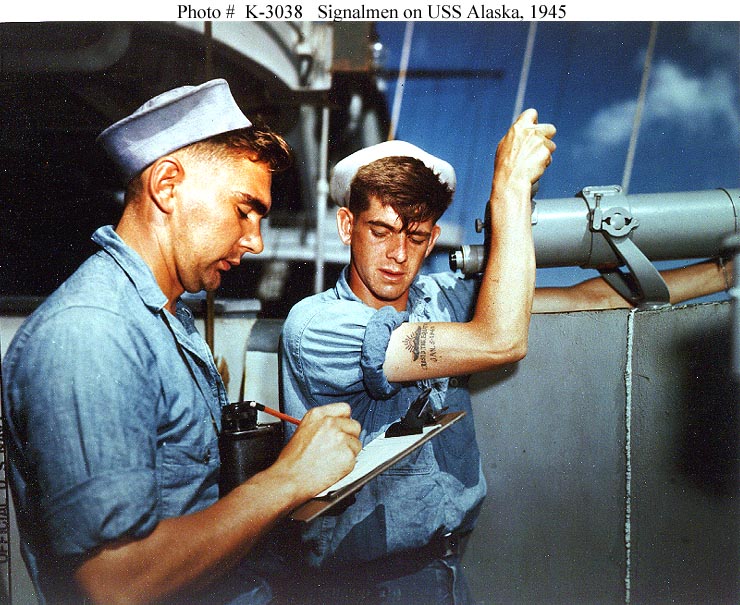
The National Park Service describes a tradition linking a swallow with 5,000 nautical miles travelled. Both the unit and the word tradition matter. The design alone cannot certify a wearer’s mileage or biography. Two birds in an old photograph are a reason to look for supporting records, not a substitute for them.
A full-rigged ship provides another useful example. The Puget Sound Navy Museum explains its connection with sailors who had rounded Cape Horn and its later use as a broader tribute to sailing. The history of the motif itself includes changes in meaning. Saying a design “has been associated with” a voyage is therefore more accurate than treating every tattooed ship as proof that its wearer completed that journey.
An Equator crossing with a catalogue record
Read a photograph without inventing a life
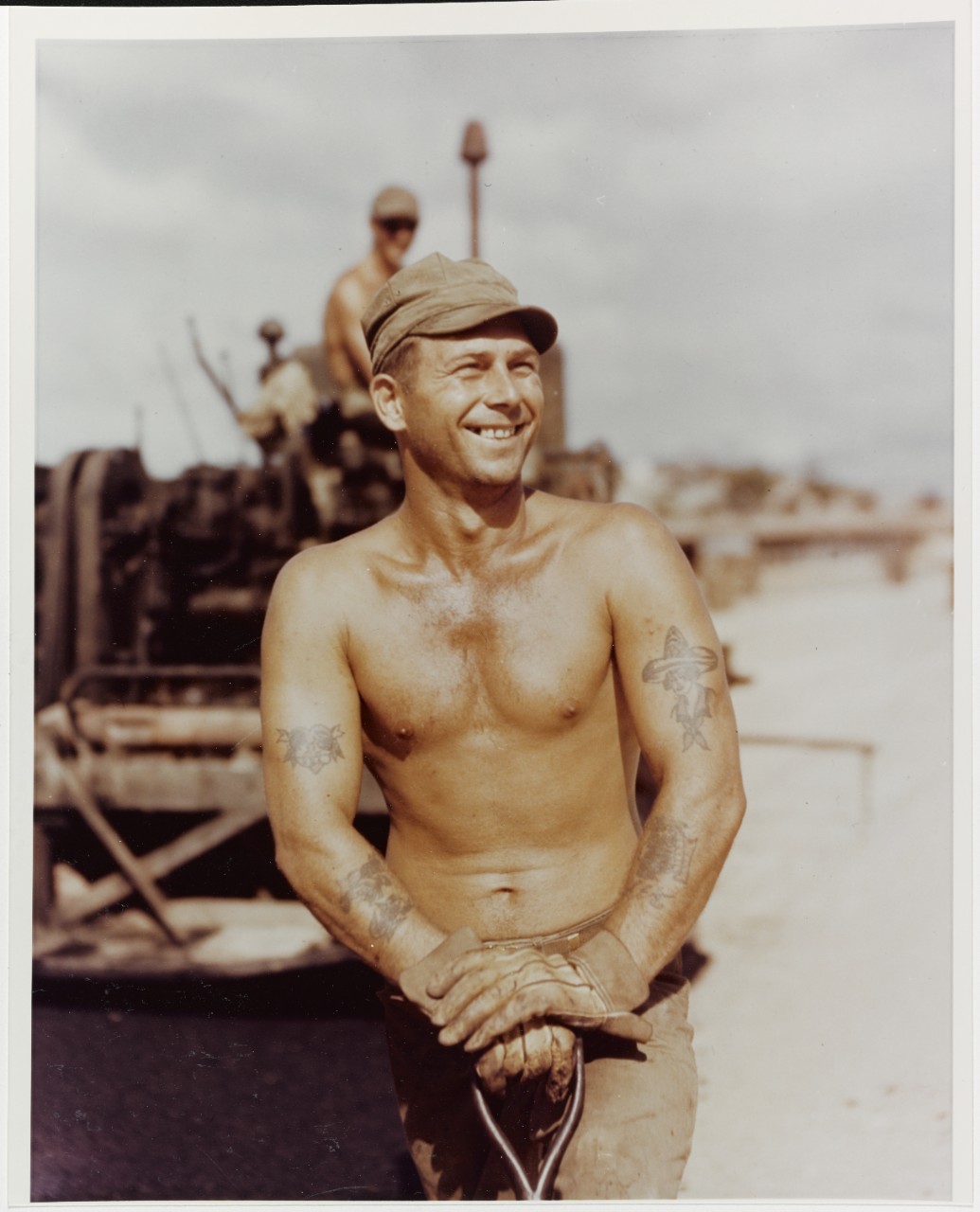
Return to the cover photograph for a moment. Its catalogue entry places Steven J. Kusial with a Seabee road construction crew on Guam in 1944. That context gives you firmer ground than a quick guess about the private significance of his tattoos.
Try dividing a notebook page into three columns: what I can see, what the archive says and what remains unknown. In the first, record placement, proportions and the relationships between designs. In the second, note the person’s name, place, date and photograph reference. The third might contain the tattoo artist’s identity, when the tattoo was made or what its wearer intended.
Leaving a question unanswered does not weaken the exercise. It stops a plausible guess from becoming a supposed fact in a caption, a portfolio description or a conversation about a new design. Observation and documentation can support one another without becoming interchangeable.
Flash also tells a story about time ashore
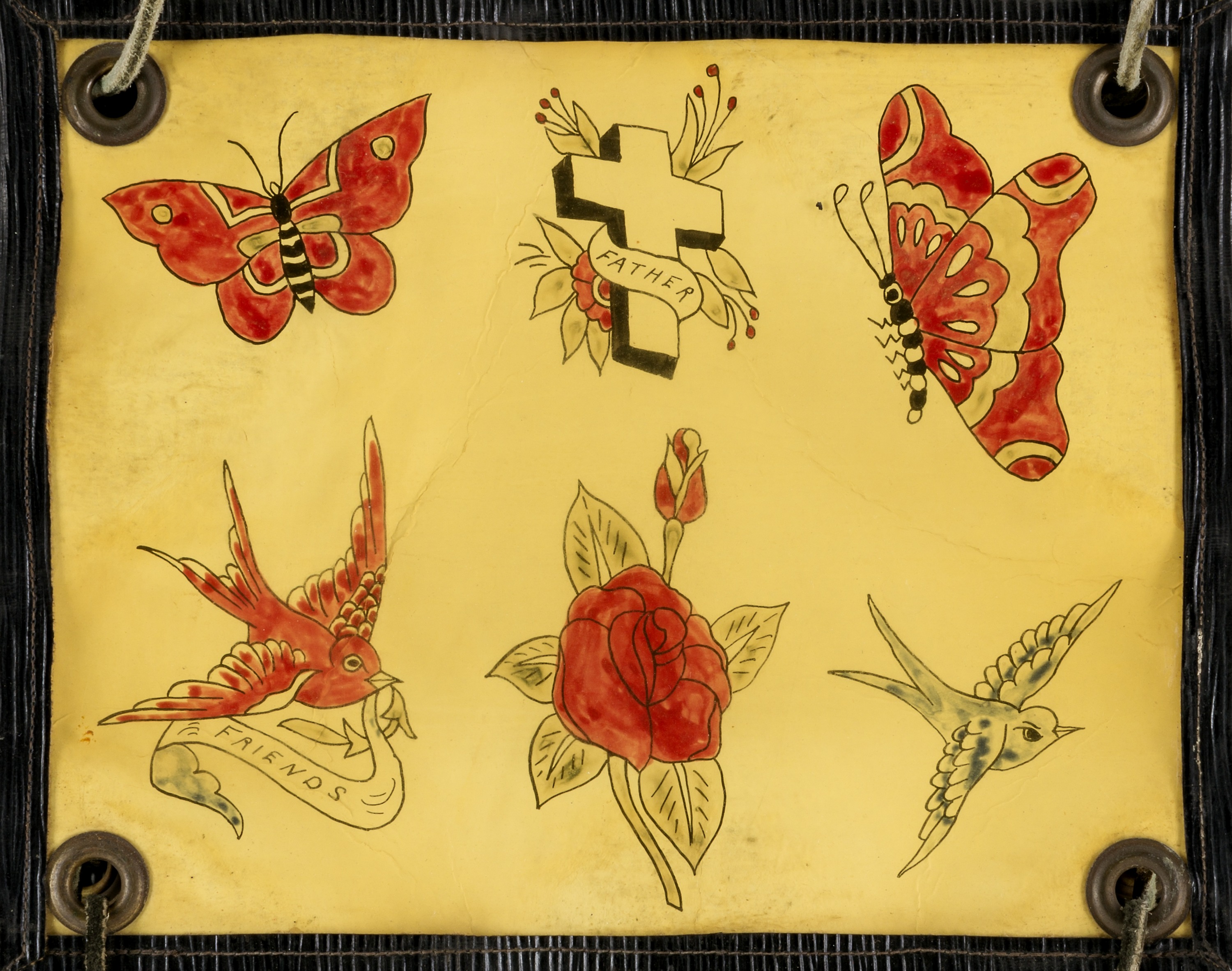
The National Park Service explains a practical reason for the spread of flash in port towns: choosing a prepared drawing saved time during a short period of shore leave. A sheet displayed the available designs and helped the tattooist organise the work. The same account describes artists exchanging designs while working in distant cities.
That adds a dimension which disappears when we only ask what a symbol means. A sheet of anchors, ships and names also tells us how a service was offered and how images travelled. The San Francisco collection includes flash sheets whose artist remains unidentified. Being held in a museum does not automatically settle authorship.
Nautical motifs overlap with the imagery of American traditional tattooing, but subject matter and visual language are different questions. For outlines, shapes and composition, continue with our American traditional guide. Here, the focus is on the social life of the images and the circumstances in which people encountered them.
A drawing exercise with context, rather than copied flash
Choose a maritime object that you can study through clear references: an anchor, a vessel or a tool. Save a picture of the object and a historical reference with its catalogue details. The first helps you understand what you are drawing; the second shows how it has been represented and in which setting. Neither needs to be a tattoo.
Make three small paper sketches with different aims. In the first, make the object immediately recognisable. In the second, introduce an explicitly fictional personal connection for the exercise, such as a remembered family journey. In the third, reduce the composition to its essential elements. Compare what happens when you add a banner, a date or another motif.
Write one sentence beside each proposal. If that sentence claims a tradition you have not checked, revise it. The point is to explain your own design decisions, not to pass off another artist’s historical drawing as your original work.
Ask before assigning a meaning
Imagine someone arriving with a saved picture of a swallow on their phone. Instead of giving a closed explanation, begin by finding out why they chose that image. They might like its silhouette, connect it with a memory, admire the artist or have read about a particular association. Those starting points lead to different decisions.
You can then offer context: “Some sailor traditions connect this motif with distance travelled. Does that history interest you, or are you looking for something else?” This is a suggested conversation, not a real interview or a rule for allocating meanings. If the reference belongs to a contemporary tattoo artist, retain their name and discuss which elements appeal to the client, without promising to reproduce their piece.
Recording those answers in a brief separates historical research from the intention behind a new design. It also leaves room for a perfectly reasonable answer: someone likes the image and does not want to attach a symbolic life story to it.
Leave with a better question
Knowing about sailor tattoos is not a way to guess a stranger’s life. It helps you look more precisely: recognise a tradition, investigate its setting and listen to what an image means to its wearer. Before saving your next reference, add the artist or archive, a date where known and one unanswered question. That small amount of work turns a folder of motifs into something you can learn from.
Sources and editorial notes
- National Park Service — Sea stories on the skin (2019)
- Royal Museums Greenwich — Facts about tattoos
- New Zealand Maritime Museum — How to Read a Sailor (2023)
- NHHC / National Archives — Steven J. Kusial, Guam, 1944, 80-G-K-2715
- U.S. Navy / National Archives — USS Alaska signalmen, 80-G-K-3038
Manufacturer and organiser facts are linked above. Our selection and reading advice expresses TattooXpert’s editorial judgement.
Our editorial methodKEEP EXPLORING.
American traditional tattoos: what drawing a rose can teach you
Study American traditional tattoo drawing through silhouette, black and colour, using a rose to explore clear composition.
TattooXpert
From tattoo idea to design brief: questions worth asking
Turn an idea into a tattoo design brief: subject, references, placement and expectations, with an example to practise before drawing.
TattooXpert